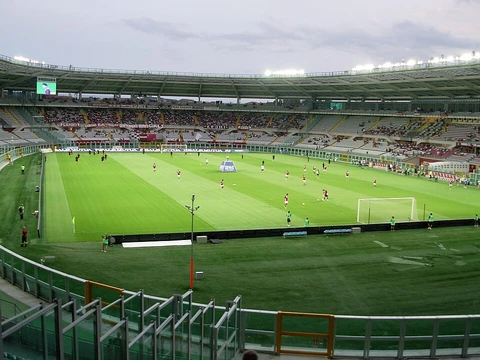
Torino vs AC Milan
Grenadiers of the hills against the red-black aristocracy of the plain — a century of quiet, bitter pride.

Torino vs AC Milan is one of Italian football's great cross-country clashes, pitting the proud, working-class 'Granata' of Turin against the cosmopolitan, European-glorified 'Rossoneri' of Milan. Both clubs are pillars of Serie A's founding generation, and their meetings carry the weight of over a century of domestic competition, contrasting footballing philosophies, and the distinct civic identities of two of Italy's most important industrial cities. Unlike the white-hot derby derbies of their respective cities (the Derby della Mole against Juventus, the Derby della Madonnina against Inter), Torino–Milan is a rivalry of mutual respect laced with quiet resentment: Torino's tragic, domestically glorious history set against Milan's relentless European dominance. It is a fixture that reminds both fanbases of what they are, and what they are not.
- Torino Serie A titles
- 7 (1927–28, 1942–43, 1945–46, 1946–47, 1947–48, 1948–49, 1975–76)
Lore & Background
The rivalry was forged in the 1930s and 1940s, when Torino's legendary Grande Torino — an all-Italian side that included Mazzola, Loik, and the great Valentino Mazzola — made the club the undisputed domestic force of the era. Milan, under Nereo Rocco's revolutionary 4-2-4 in the 1960s, answered with two European Cups and a continental identity that Torino, still mourning the 1949 Superga air disaster that killed its entire first team, could never match. The psychological gulf between the two clubs became a defining feature of every subsequent meeting: Torino playing with the ferocity of a city that had lost everything, Milan playing with the confidence of a club that had conquered Europe. The 1970s brought a brief Torino renaissance under Luigi Radice, whose Scudetto in 1975–76 reminded the football world that the Granata could still outclass anyone on the domestic stage. Against Milan in that period, Torino's physical, direct, hard-running style was a deliberate counter to the Rossoneri's more technical, possession-oriented approach. Those matches, played in the cold, echoing Stadio Comunale (later renamed Stadio Olimpico Grande Torino) or the vast San Siro, carried an almost ritualistic intensity: each side knew the other was the benchmark of what the other was not. In the modern era the rivalry has cooled in public temperature but not in private memory. Torino's long exile from Serie A and Milan's fluctuating fortunes have made the fixture less frequent, but when the two sides do meet, the old narratives resurface — the Grande Torino's ghost, the seven stars above Milan's badge, the unspoken question of whether domestic glory or European glory is the truer measure of a club's soul. For a Granata, beating Milan is not just three points; it is a small, necessary act of defiance against a century of narrative that places Torino in the shadow of its more celebrated rivals.
In Their Own Story
November, 1976. The Stadio delle Alpi is a cauldron of grey sky and black smoke from the away end. Torino's away kit — the old white, the Bianchi's ghost — sits in the dressing room like a dare. Boškov has drawn up the team in the corridor, chalk dust on his fingers, and he does not look at the Milan squad sheet. He does not need to. He knows they will come with the ball, with the patience of a city that has always believed it deserves the world. Torino will not be patient. Torino will run. Torino will hit the ball into the space where the Milan full-backs think the game is being played, and they will not stop until the ball is in the net or the whistle blows. In the stands, a woman in a faded granata scarf — her husband played for the Biancheria, he never came home from Superga — presses her lips together and does not pray. She does not need to. She has already won. She just has to watch.
Reader's Guide
The Torino–AC Milan rivalry is best understood not as a derby but as a civilizational argument played out on a pitch. Turin and Milan are Italy's two great industrial capitals, yet they speak different dialects of ambition. Turin built its identity around the automobile, the factory, the working man's pride; its football club inherited that ethos — direct, physical, unglamorous, and capable of extraordinary domestic dominance. Milan, the city of commerce and design, built a club that aspires outward: the European Cup, the global brand, the beautiful game as spectacle. When these two meet, the tension is not merely tactical. It is a question of values: is greatness measured by the Scudetto you win at home, or by the trophy you lift in Wembley or Rotterdam? The historical context deepens the divide. Torino's 1949 Superga disaster — the air crash that killed the entire Biancheria squad and staff — left a wound that no amount of subsequent success could fully close. Milan, by contrast, has enjoyed a long, if sometimes interrupted, reign at the top of European football. The rivalry therefore carries an undercurrent of mourning versus triumph that no amount of sporting parity can erase. For a Granata who grew up in the shadow of the Allianz (or, before it, the Stadio delle Alpi), a Milan victory is not just a loss of points; it is a reminder of the trajectory the club was denied. And for a Rossonero, a Torino win is an unwelcome reminder that domestic football still has a soul that cannot be bought with European pedigree. The most heated encounters tend to cluster in the 1940s, 1970s, and the early 2000s, when both clubs were in the same division and the stakes were high. In those years, the matches were played with a ferocity that transcended the scoreline — fouls that drew red cards, goalkeepers who became field players, and a post-match atmosphere in which neither side could bring themselves to applaud the other. That mutual, grudging respect is the truest measure of the rivalry: these are not enemies. They are two halves of Italian football's identity, arguing about which half matters more.
Did You Know?
- Torino's 1949 Superga air crash killed the entire Granata first team and coaching staff in a single event, making it one of the deadliest disasters in football history and a defining trauma for the club.
- AC Milan's seven European Cup / Champions League titles (1963, 1969, 1989, 1990, 1994, 2003, 2007) make them one of the most successful clubs in the competition's history, a record Torino has never matched.
- Torino's back-to-back titles in 1975–76 and 1976–77 under Vujadin Boškov is a common misconception; in fact, Torino won only in 1975–76 under Luigi Radice, while 1976–77 was won by Juventus.
Frequently Asked Questions
What is the Torino vs AC Milan rivalry?
It is a cross-country clash between Turin's working-class Granata and Milan's cosmopolitan Rossoneri, two of Serie A's founding-era clubs meeting for well over a century. Rather than a single-city derby, the fixture contrasts two industrial cities' footballing philosophies and civic identities.
How does Torino vs AC Milan differ from the Derby della Mole or Derby della Madonnina?
Those derbies pit immediate neighbors against each other within one city, while Torino-Milan is a cross-country affair between two distinct regional identities. The rivalry carries the weight of hills-versus-plains pride and working-class grit versus European-glorified ambition, without the acute geographic tension of a local derby.
Why is Torino vs AC Milan important in Italian football history?
Both clubs belong to Serie A's founding generation, so their head-to-head record spans more than a century of domestic competition. The fixture also encapsulates the broader divide between Italy's northern industrial powerhouses, from Torino's seven league titles to Milan's nineteen.
What is the trophy gap between Torino and AC Milan?
AC Milan holds 19 Serie A titles and seven European Cups, whereas Torino's tally stands at seven league titles and zero European Cups. That disparity underpins much of the quiet, bitter pride Torino fans feel toward the more globally celebrated Rossoneri.
What do Torino and AC Milan represent to their respective cities?
Torino embodies the proud, working-class identity of Turin's hills—often styled the 'Grenadiers of the hills'—while AC Milan stands for the red-black aristocracy of the plain and its cosmopolitan, European ambitions. Their meetings are less about one city's ego and more about two distinct Italian industrial cultures asserting themselves on the pitch.
More in Great Rivalries
Elsewhere in the Torino FC universe
Spotted an error? Know more?
This is a living reference — every entry is fact-audited, and reader corrections feed straight into our audit queue. Suggest an edit · See this site's audit record