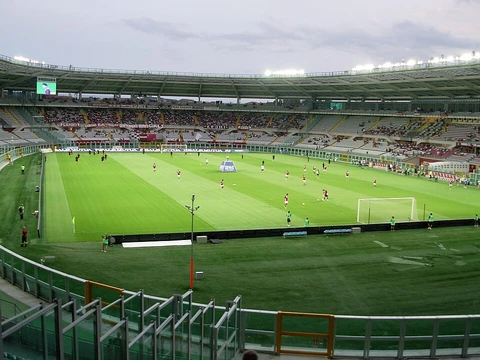
Torino vs Napoli
Granata and Azzurri: where northern establishment meets southern revolution.

Torino vs Napoli is one of Italian football's most storied north-south clashes, pitting the granata establishment of the Po Valley against the azzurri revolution of the Bay of Naples. It is not a derby in the geographic sense—there is no shared city, no single neighbourhood split down the middle—but it carries the weight of two clubs that defined their respective regions for decades and whose peaks of power rarely overlapped, creating a rivalry built as much on mutual respect and historical contrast as on raw animosity. For Torino fans, Napoli represents the great 'what if' of the 1980s: the decade when the southern club, armed with Maradona, seized the Scudetto and rewrote the map of Italian football while Torino languished in the lower half of the table. For Napoli supporters, Torino is the ghost of the Grande Torino, the team that dominated the mid-1940s before Superga erased them, a reminder of what a club can be when it is at the absolute pinnacle. The fixture is a mirror held up to two different eras of Italian dominance.
- Torino founded
- 1906
- Napoli founded
- 1926
- Torino's last Scudetto
- 1975–76
- Torino identity
- Granata (dark red/maroon), 'Il Toro', Torino, Piedmont
- Napoli identity
- Azzurro (light blue), 'Il Napoli', Naples, Campania
- Rivalry axis
- Northern industrial establishment vs. southern Mediterranean power
Lore & Background
The rivalry's roots are less about a single incident and more about the structural geography of Italian football. Torino, born in 1906 in the industrial heartland of Piedmont, became the face of northern football in the 1940s. The Grande Torino of Mazzola and the other legendary names won four consecutive Scudetti (1942–43, 1945–46, 1946–47, 1947–48) and were, in the words of the era, the best team in the world. Then, on 4 May 1949, the Superga air disaster killed the entire squad and staff. Torino never fully recovered that mythic status, but the club carried the weight of that loss into every subsequent season, a permanent elegy stitched into the granata shirt. Napoli, by contrast, was a young club in the 1940s and 1950s, a mid-table presence in a league dominated by the northern giants. The transformation came in the 1980s. The arrival of Diego Armando Maradona in 1984 turned a provincial southern club into a continental powerhouse. For Torino, watching from the lower reaches of the table in that same decade, the message was painful: the old order had been overturned, and the new kings wore azzurro. The rivalry intensified further in the 1990s and 2000s as Napoli, under various managers, continued to push for the top of the table while Torino struggled with financial and sporting instability, including a period in Serie B. The contrast between a club that had once been the best in the world and one that was fighting to survive gave the fixture an almost existential edge. When the two sides met, it was not just three points; it was a conversation between two different definitions of what a 'big' Italian club should be.
In Their Own Story
The floodlights at the Stadio Olimpico hummed with a low, electric buzz. It was a November evening, the kind where the Piedmont fog creeps up from the Po and settles on the terraces like a grey wool blanket. In the granata end, a father and his son sat shoulder to shoulder, the son no older than twelve, his small hands gripping the back of the seat in front of him. Now his son was here, in the flesh, in the cold, and the azzurri bus was already pulling into the away parking area. The son looked up. 'Papa, why do we hate them so much? They're just a team from the south.' The father did not answer for a long time. Then he said, 'They're not just a team. They're the proof that we could have been something else. And they took it.' The whistle blew. The son did not fully understand. He would, eventually.
Reader's Guide
To understand Torino vs Napoli, you must first understand the Derby della Mole—the clash with Juventus that defines Torino's identity, its city split, its most visceral hatred. That is the flagship rivalry, the one that lives in every granata fan's bones. Torino vs Napoli is the secondary axis, and its animosity operates on a different frequency. It is not born of shared geography or a single bitter season. It is born of era, of north versus south, of what Italian football was in the 1940s versus what it became in the 1980s. Torino carried the crown of the Grande Torino into the post-war years; Napoli seized the crown in the 1980s and never let go. The rivalry is, at its core, a rivalry between two different definitions of greatness that occupied the same league at different times, and the resentment of the one that came second. For a fan who grew up in the shadow of the Allianz, the Napoli match is the one where you are not the underdog in a city derby; you are the old king meeting the new one, and the scoreline, for once, is almost secondary to what the fixture says about where your club stands in the long story of the sport. The animosity is amplified by the north-south divide that runs through Italian culture. Torino is industry, fog, the Po, the Alps. Napoli is the sea, the volcano, the crowd that sings. When the two meet, it is not just football; it is a collision of two Italian identities, and the granata end and the azzurri end each carry the full weight of their city's pride. That is what makes the fixture more than a mid-table scrap, even in seasons when neither team is challenging for the title.
Did You Know?
- Torino's four consecutive Scudetti (1942–43, 1945–46, 1946–47, 1947–48) were won by the 'Grande Torino,' the team annihilated in the Superga air disaster of 4 May 1949—a loss that permanently altered the club's trajector
Frequently Asked Questions
Is Torino vs Napoli a derby?
No—there is no shared city or neighbourhood dividing the two sides. It is a north-south rivalry between two clubs that each dominated their own region for decades, and it carries more historical weight than most true derbies.
Why is Torino vs Napoli considered one of Italy's great rivalries?
The two clubs embodied opposing identities—Piedmont's industrial granata establishment against Campania's azzurri revolution—and their eras of peak dominance rarely overlapped, so every meeting felt like a chapter in a longer, unresolved story rather than a simple fixture.
What does Napoli symbolise for Torino supporters?
For granata fans, Napoli is the great 'what if' of the 1980s: the southern club that seized the Scudetto and European glory at the very moment Torino were slipping off the top of Italian football.
What is the fundamental axis of the Torino vs Napoli rivalry?
It pits northern industrial establishment against southern Mediterranean power, granata against azzurro, the Po Valley against the Bay of Naples. The contrast is as much cultural and geographic as it is sporting.
How does Torino's 1975–76 Scudetto fit into the rivalry with Napoli?
Torino's last league title came a full decade before Napoli's golden era began, which is precisely why the rivalry feels like two peaks that never quite met on the same summit. That gap makes each subsequent meeting a reminder of what was and what could have been.
More in Great Rivalries
Elsewhere in the Torino FC universe
Spotted an error? Know more?
This is a living reference — every entry is fact-audited, and reader corrections feed straight into our audit queue. Suggest an edit · See this site's audit record