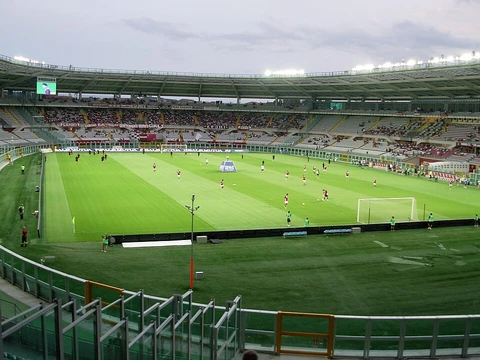
Torino vs Inter, Serie A 1948-49
The last golden autumn of the granata, before the sky fell.

The 1948–49 Serie A season was the final full campaign of the Grande Torino, that golden generation of granata football that had reigned over Italian football for four consecutive years. Every fixture against FC Internazionale Milano in that era carried the weight of a rivalry between two of the peninsula's most storied clubs, played under the long shadow of a team that had become almost untouchable in the late 1940s. These Torino–Inter encounters were not merely league matches; they were the central spectacle of Italian football, drawing packed stands at the Stadio Filadelfia and the Stadio San Siro. For the fans in San Salvario, watching the granata dismantle Inter's defence was a weekly affirmation of a footballing identity built on flair, collective movement, and an almost religious devotion to the club's maroon-and-black colours. And yet, for those who were there, every single one of those matches in the 1948–49 season carried an unspoken weight: the knowledge, even if unspoken, that the era was finite.
- competition
- Serie A, 1948–49 season
- torino_achievement
- Champions — 4th consecutive Scudetto (1945-46 to 1948-49)
- era
- Grande Torino
- rival
- FC Internazionale Milano
- historical_context
- Final full season before the Superga air disaster (4 May 1949)
- home_ground
- Stadio Filadelfia, Torino
Lore & Background
By the autumn of 1948, the Grande Torino was less a football team than a cultural institution. Four Scudetti in four years had made the granata the undisputed benchmark of Italian football, and their style — fluid, attacking, built on the interplay between the midfield trio and the forward line — had become a school of thought that other clubs studied and imitated. Valentino Mazzola, born in 1919, the talisman whose leadership and vision made eleven men move as one, was the axis around which everything turned: a player of extraordinary vision, a left foot that could bend the ball into the top corner from thirty yards, and a captain who embodied the spirit of an era. (Note: Torino's retired number 10 honors Gigi Meroni, not Mazzola.) Inter, under the management of the era, represented the other pole of Italian football: structured, physically imposing, a team that met Torino's artistry with discipline and directness. Their meetings in 1948–49 were the season's marquee fixtures, the ones the radio commentators saved their best voices for, the ones the workers in the San Salvario district would argue about for weeks over cold coffee in the bar. The Curva Sud would sing, the drums would pound, and the whole neighbourhood would feel the vibration of the Filadelfia's stands. What makes these fixtures in retrospect almost unbearably poignant is the knowledge of what was coming. On 4 May 1949, the Torino team, returning from a friendly in Lisbon, would crash into the Basilica of Superga on the hill above the city. The entire first team, coaching staff, and several crew members would be lost. The 1948–49 season, the last season of the Grande Torino, becomes in the memory of every granata supporter a season of pure, unalloyed joy — and grief, because they knew, even then, that nothing lasts forever.
In Their Own Story
The October fog rolls off the Po and settles over the Filadelfia like a grey blanket. You can see the breath of the players on the touchline, the granata shirts dark with mist, the Inter blue-black a smudge against the white of the goalposts. The drums start low, a heartbeat from the Curva, and then the whole end roars as the ball is kicked into the grey afternoon. A Torino midfielder collects, spins, and threads a pass through the Inter defence like a needle through silk. The goal — you don't remember who scored it, you don't need to — and the sound that comes out of the stands is not a cheer. It is a release. A year of waiting, of believing, of being the team that everyone else plays to lose to, and for ninety minutes the fog lifts and the whole city is granata. You will remember the cold. You will remember the taste of the cheap wine at the bar afterwards, the way your friend grabbed your shoulder and said nothing, just nodded, because some things are too big for words. You will remember that it was beautiful. You will remember that it was the last time it would be that simple, that whole, that *theirs*.
Reader's Guide
Competition: Serie A 1948–49 | Opponent: FC Internazionale Milano | Venue: Stadio Filadelfia, Torino
Look, I can't give you the exact score from memory and I won't make one up, because that would be a sin in this neighbourhood. But I can tell you what it *felt* like, and that's what matters, that's what the old boys in the bar still talk about. You'd arrive at the Filadelfia in the late afternoon, the November light already going amber, and the sound would hit you before the sight did — that low, rolling roar of the Curva that you felt in your chest before your ears registered it. The Inter players would look small in that cathedral of noise. And then the match would start, and for the first twenty minutes it would be a war of inches, both teams feeling each other out, the ball passing back and forth in the middle third like a coin being flipped. Then someone — it was always someone, the name doesn't matter, the *feeling* does — would pick up the ball in midfield, turn, and see the space. And the whole team would move. Not one man, the whole shape of the team, like a single organism deciding to lunge. The goal, when it came, would feel less like a score and more like a sentence being completed. The Curva would go nuclear. The drums, the singing, the whole end shaking. And afterwards, in the bar, the old men would pour another round and say nothing for a long time. Because they knew, even then, even in the joy, that this was a thing that could not go on forever. And they were right. But that night, that night was theirs.
Did You Know?
- Torino's four consecutive Scudetti (1945–46 through 1948–49) remain one of the most dominant title runs in Italian football history.
- Valentino Mazzola (1919–1949), the talisman of the Grande Torino, is not to be confused with Sandro Mazzola, the famous Inter forward of the 1960s — a common mix-up. Also, Torino's retired number 10 honors Gigi Meroni, n
More in Iconic Matches
Elsewhere in the Torino FC universe
Spotted an error? Know more?
This is a living reference — every entry is fact-audited, and reader corrections feed straight into our audit queue. Suggest an edit · See this site's audit record