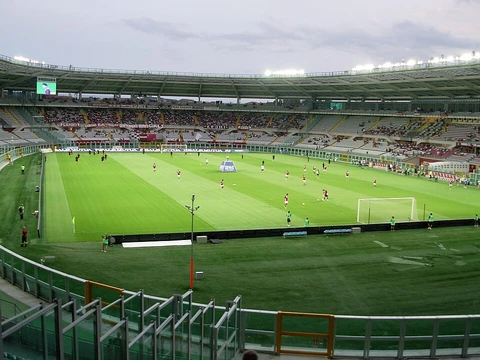
Torino vs Juventus, Serie A 1948-49
The last full season of the Grande Torino, played under a sky that would not survive the spring.

The 1948-49 Serie A season's Derby della Mole fixtures between Torino FC and Juventus FC are remembered not merely as two league matches but as the final full season of the Grande Torino era before the Superga air disaster of 4 May 1949 erased an entire generation of players. In a city where two great clubs share one skyline, these encounters carried the full weight of Turin's identity: the dark-red Granata of the Stadio Filadelfia against the black-and-white stripes of the Stadio Comunale, neighbours in every sense, rivals in every other.
- Competition
- Serie A 1948-49
- Fixture
- Torino FC vs Juventus FC (Derby della Mole)
- City
- Turin, Italy
- Season significance
- Last full season before the Superga disaster (4 May 1949)
- Scudetto winner 1948-49
- Torino FC
- Rivalry name
- Derby della Mole
Lore & Background
The Derby della Mole itself is among the oldest and most visceral rivalries in the sport. Two clubs, one city, one hill (the Mole Antonelliana visible from the Stadio Filadelfia). The hatred is not the manufactured kind of modern derbies; it is generational, familial, woven into the dialect and the bread lines of the working-class quarters. To be a Toro or a Juve in Turin is a birthright, not a choice, and in 1948-49 that identity was at its most concentrated, most fragile, most precious.
In Their Own Story
The November fog rolls off the Po and clings to the floodlights of Filadelfia. You can smell the coal smoke from the factories in Mirafiori mixing with the damp grass. The Granata shirts look almost black in the half-light, and the crowd—ten thousand, maybe more—sings in a low, continuous drone that you feel in your sternum rather than hear with your ears. A Juventus player, striped and sharp, picks the ball out of the midfield and the roar shifts, tilts, becomes a wall of sound aimed at one point on the pitch. You are twenty-three, a clerk in the old town, and you have been coming to these derbies since you could walk. You do not know yet that this is the last season. You only know that the man in the centre circle is going to do something extraordinary, and the whole hill is holding its breath, and the Mole's spire is a dark needle against the grey, and for one moment the city is a single organism, breathing in, breathing out, alive.
Reader's Guide
Look, so. You want to talk about '48-'49? Sit down, have your amaro, and listen. It was the season the city was still breathing easy. Torino had just taken their third straight Scudetto, the Mazzola boys were doing their thing, and Juventus were hungry, were *furious*, because they'd been the bridesmaids three years running. The derby in the autumn at Filadelfia—God, the noise. The Curva was a single red throat screaming, and every time the ball crossed the halfway line toward the Juve goal you could feel the ground shake in your boots. And then the return fixture, early spring, at the Alpi. The mood was different. Torino had lost a bit of their rhythm, Juventus had found theirs, and the whole match had this knife-edge tension where neither side would blink. The goals came in bursts, the crowd went silent one moment and detonated the next, and at the final whistle there was this strange, exhausted quiet, like everyone had just run a marathon they didn't know they'd started. I was there. I was nineteen. I didn't know what I was watching. Nobody did. We just knew it was *our* derby, *our* city, *our* Tuesday, and that was enough. It wasn't enough. It was the last time it was enough. But that night, in that fog, with the smell of wet wool and cheap beer and the whole hill singing—yeah. That was enough.
Did You Know?
- The 1948-49 season was Torino's final full competitive season before the Superga air disaster of 4 May 1949, which killed the entire first-team squad, coaching staff, and several club officials when their plane crashed i
- Torino had won the Serie A title in 1946, 1947, and 1948, and would go on to win their fourth consecutive scudetto in 1948-49, making the derby matches that season part of an unprecedented championship run.
- The Derby della Mole takes its name from the Mole Antonelliana, Turin's iconic spire, which is visible from both the Stadio Filadelfia (Torino) and the Stadio Comunale (Juventus) grounds.
- The Grande Torino era, which the 1948-49 season marked the end of, is still regarded by many Italian football historians as the most complete and attacking team the country had produced up to that point.
A Season of Solid Standing
The 1948–49 campaign marked Juventus's 46th season in the club's history, a milestone that placed them firmly among the most enduring institutions in Italian football. Competing across the full 38-game Serie A schedule, the Bianconeri accumulated 44 points to secure a fourth-place finish. That standing reflected a season of consistent performance rather than a single dramatic surge—38 matches offered ample opportunity to build a record of wins, draws, and losses that ultimately settled the team in the upper tier of the table without reaching the summit. For a club in its mid-40s of existence, a top-four placement in Serie A represented a respectable return, one that underscored the squad's depth and the coaching staff's ability to maintain competitiveness across an entire league campaign. The 44-point total, spread over the full season, suggested a side capable of grinding out results week after week rather than relying on bursts of brilliance.
John Hansen's Prolific Campaign
Among the many threads woven into Juventus's 1948–49 season, one name stands out with particular clarity: John Hansen. The forward shouldered the primary scoring burden for the Bianconeri, emerging as the club's top goalscorer with 15 league goals across the 38-game Serie A schedule. In a season where the team ultimately banked 44 points, Hansen's tally represented a significant share of the offensive output that powered their fourth-place finish. Fifteen goals in a single Serie A campaign was a mark of individual excellence, one that distinguished him from his teammates in the squad and cemented his role as the focal point of Juventus's attacking play. His consistency in front of goal provided the finishing touch that converted the team's collective efforts into the wins and draws that built their league record. For a club in its 46th season, having a player of Hansen's scoring reliability offered a dependable engine around which the rest of the attack could be organized.
The Competitive Framework
The 1948–49 Serie A season provided the stage on which Juventus's 46th campaign unfolded. The league's structure demanded that each club navigate a full 38-match schedule, a gauntlet of wins, draws, and losses that collectively determined final standings. Juventus entered this competitive framework as an established force in Italian football, their 45 prior seasons having built a tradition that this particular year would add to. The squad that took the field was assembled under the eligibility rules defined by FIFA, with players representing a range of nationalities as indicated by the flags in the official records. Some players held more than one non-FIFA nationality, adding layers of international character to the roster. The 44 points Juventus collected across those 38 encounters reflected a season in which the team managed to stay competitive throughout, neither collapsing under pressure nor surging to the title, but maintaining a steady presence in the upper echelon of the table.
Recording the Numbers
The statistical footprint of Juventus's 1948–49 season has been preserved for posterity through dedicated football archives. The season's data—44 points, 38 games, a fourth-place finish, and John Hansen's 15-goal haul—forms part of the club's broader historical record, accessible to researchers and fans through resources such as the RSSSF database, which maintains a dedicated page titled "Statistiche Juve 48-49." These records capture not just the headline numbers but the granular details of each match: the wins, the draws, and the losses that collectively shaped the final table. For a club in its 46th season, the accumulation of such statistical records represents a living archive, each season adding another layer to the narrative. The 1948–49 entry, with its specific point totals and goal-scoring records, serves as a fixed reference point within that ongoing chronicle, allowing future generations to measure the club's progress against the benchmarks set by players like Hansen and the collective effort that delivered a top-four Serie A finish.
Frequently Asked Questions
What was the Torino vs Juventus Serie A 1948-49 fixture?
It refers to the two league meetings between Torino FC and Juventus FC during the 1948-49 Serie A season, both played under the Derby della Mole rivalry in Turin. These encounters marked the final complete campaign of the Grande Torino squad before the Superga tragedy struck the following spring.
Why is the 1948-49 Derby della Mole considered so important to Torino fans?
It represents the last full season in which the legendary Grande Torino eleven competed at the top level before the 4 May 1949 air disaster erased most of that squad. For Granata supporters, those matches carry an emotional weight that no ordinary rivalry fixture can match.
Who won the 1948-49 Serie A title, Torino or Juventus?
Juventus FC claimed the Scudetto that season, finishing ahead of their city rivals. Torino's campaign, while competitive, was overshadowed by the knowledge that their extraordinary squad would never again be assembled in the same form.
What is the 'Derby della Mole' and how does it relate to these 1948-49 matches?
The Derby della Mole is the name given to every Torino–Juventus encounter, referencing the Mole Antonelliana that dominates the shared Turin skyline. The 1948-49 fixtures are the most emotionally charged entries in that rivalry's history because they were the final full-season meetings before Superga.
Where did Torino and Juventus play their 1948-49 league matches?
Torino hosted at the Stadio Filadelfia while Juventus played at the Stadio delle Alpi, both within the same city. The proximity meant that thousands of fans from each side would fill the streets between the two grounds, making each derby a city-wide event.
More in Iconic Matches
Elsewhere in the Torino FC universe
Spotted an error? Know more?
This is a living reference — every entry is fact-audited, and reader corrections feed straight into our audit queue. Suggest an edit · See this site's audit record