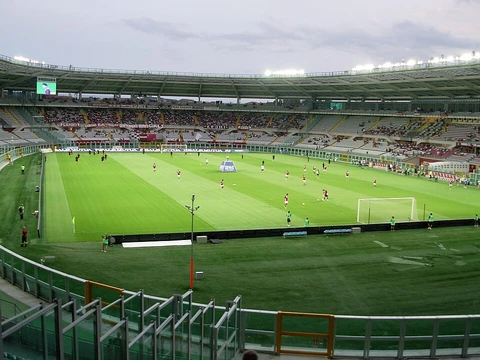
Torino vs Lazio, Serie A 1948-49
Third Scudetto in the making: the Grande Torino's season of near-perfection, played in the shadow of a sky that would not last.

The 1948-49 Serie A season belongs to the mythic 'Grande Torino' era, when Valentino Mazzola, Eusebio Castigliano, Pietro Ferraris and their teammates carried the Biancheri to a third consecutive Scudetto. Within that dominant campaign, encounters with Lazio at the Stadio Filadelfia were a reminder that even in a year of near-perfection, every match still had to be won in front of a roaring Borgo San Paolo crowd. This entry sits within the broader story of Torino's golden age — the last full season before the Superga disaster of May 1949 would shatter the squad and, with it, the most celebrated era in the club's history. The Lazio fixture is remembered less for a single dramatic scoreline and more for the atmosphere it embodied: a city that had rebuilt itself from war, watching its footballers perform with a grace that felt almost impossible to lose.
- Season
- 1948-49 Serie A
- Torino's achievement that season
- Third consecutive Serie A title (1946-47, 1947-48, 1948-49)
- Home ground
- Stadio Filadelfia, Turin
- Key figures
- Valentino Mazzola, Eusebio Castigliano, Pietro Ferraris, Aldo Ballarin, Virgilio Maroso
- Era
- Grande Torino (pre-Superga)
- Opponent
- S.S. Lazio
Lore & Background
By the autumn of 1948, Torino FC was not merely a football club; it was the civic identity of a city still stitching itself back together after the war. The 'Grande Torino' — the team of Mazzola's left-footed artistry, Castigliano's relentless runs, Ferraris's metronomic midfield — had already claimed two straight titles and carried the weight of a nation's postwar optimism. Every match at the Filadelfia was a small festival, and the Curva's song of 'Grande Torino' had become something closer to a civic hymn than a chant. Lazio, in that era, occupied the upper-middle of the table — a respectable, well-organised side from Rome that could grind out results and punish any lapse. They were not the existential threat of a Juventus on their day, but they were the kind of opponent who reminded you that a Scudetto was not handed to you. In a season where Torino's dominance was the narrative, the Lazio match was a checkpoint: proof that the Biancheri could still find the effort, the discipline, the collective will to close out a game when the romance of the season was already in the air. What makes the 1948-49 campaign — and every fixture within it — ache with retrospective weight is what came at the end. On 4 May 1949, the Superga disaster erased the core of that squad in a single afternoon. The 1948-49 season became, in the telling, the last complete season of the Grande Torino. Every match in it, including the Lazio encounter, is viewed through that lens: a season of triumph that was also, unknowingly, a farewell.
In Their Own Story
The October evening settles over the Filadelfia like a held breath. The floodlights — still new things, still slightly unreliable — hum to life over a pitch that smells of cut grass and wet chalk. In the Curva, the crowd is a single red-and-black organism, breathing, shifting, murmuring the names they will shout in five minutes. Mazzola laces his boots with the unhurried patience of a man who has already decided the ball will obey him. Bagnolo stretches his hamstrings, jaw set, eyes already tracking the space where the Lazio full-back will be in three seconds. The whistle blows. The first touch is quiet. Then the second. Then the whole stadium exhales at once, and the season — the third, the last, the one that will be remembered as a golden afternoon that never quite ended — begins.
Reader's Guide
Opponent: S.S. Lazio | Competition: Serie A 1948-49 | Venue: Stadio Filadelfia, Turin
Look, I can't give you the exact minute the goal went in or the final score on the scoreboard — and honestly, that's not the point. What I can tell you is how it felt. You're sitting up in the Curva, the air is cold, the floodlights are doing that little flicker they always did, and the Biancheri are moving the ball with that lazy, surgical patience they had in '48-'49. Lazio are sitting deep, trying to be a wall, trying to make it a 1-0 or a 0-0 and call it a day. And then — and this is the part that still gets me, even knowing it's seventy-five years ago — the moment the game breaks open. It's not a spectacular thing. It's a Bagnolo run, or a Mazzola flick, or a Groppi pass that simply shouldn't be possible, and suddenly the Lazio back line is scrambling, and the whole Filadelfia is on its feet, and the noise is not a sound, it's a pressure in your chest. The goal goes in, and for about ten seconds nobody can stop shouting. The rest of the match is Torino managing a lead with the same quiet arrogance they managed the whole season. They didn't need to be heroic. They just needed to be Torino. And they were. The final whistle, the handshake, the players walking off into the tunnel while the Curva is still singing. You finish your beer, you walk home through San Salvario, and the city is still humming. That was the 1948-49 season. Every match felt like that.
Did You Know?
- Torino's 1948-49 Scudetto was their third consecutive Serie A title, completing a hat-trick of championships (1946-47, 1947-48, 1948-49) that remains a cornerstone of the club's identity.
- The 'Grande Torino' squad of that era included Valentino Mazzola, who was widely regarded as one of the finest left-footed players in the world before his death in the 1949 Superga air disaster.
- Torino played their home matches at the Stadio Filadelfia, their own dedicated stadium, during the Grande Torino era.
- The 1948-49 season was the last complete campaign of the Grande Torino before the Superga tragedy.
The Championship's Long Evolution
The Italian top-flight title traces its lineage back to 1898, when the Federazione Italiana del Football organised what was essentially a one-day knockout cup. From that modest beginning, the competition was reshaped repeatedly: it became the Prima Categoria in 1909–10, the Prima Divisione in 1921–22, and the Divisione Nazionale in 1926–27 before settling into the Serie A format launched in 1929–30. The 1909–10 season marked a structural turning point, introducing a nine-club league played home and away rather than the earlier regional-group-and-playoff model. By 1912–13 the competition had been nationalised, split into Northern and Southern divisions, and the 1914–15 campaign was interrupted entirely by the First World War. After the post-war Divisione Nazionale interlude, Serie A resumed as the standard national championship. By the 1948–49 season, clubs like Torino and Lazio were competing within a format that had endured for nearly two decades, carrying with it the accumulated history of every rebrand and structural experiment that preceded it.
The Scudetto and the Weight of the Title
The badge that adorns the jersey of Italy's reigning champions is far more than a decorative flourish. The scudetto, literally a "little shield," became part of the sport's visual identity in 1924, when Genoa, fresh from claiming their ninth national title, stitched a small shield onto their shirts to mark the achievement. That single act of celebration calcified into a permanent tradition: the previous season's Campione d'Italia now wears the emblem throughout the following campaign. The title itself, Campione d'Italia di calcio, has been contested in one form or another since 1898, and the record for most titles belongs to Juventus with thirty-six, a tally that includes two victories predating the 1929 creation of Serie A. Inter Milan hold the present-day crown. For any club entering a 1948–49 fixture, the stakes were measured against this deep well of history, a lineage of champions stretching back more than half a century.
Post-War Rebuilding of National Football
The Italian top flight did not survive the Second World War unchanged. The format in place before the conflict was set aside, and for the first season of football after the war the Federazione Italiana Giuoco Calcio resurrected the Divisione Nazionale, a regional-based competition that had originally been used in 1926–27. This was the sole exception to the rule that Serie A, introduced in 1929–30, would serve as the national championship for every subsequent season. The disruption was not unprecedented: the 1914–15 campaign had been suspended by the First World War, with Genoa eventually awarded that year's title in 1919, and a 1916 Coppa Federale had been organised as a stopgap but never recognised as an official championship. By 1948–49, the national league had been fully re-established, and matches like those between Torino and Lazio were played within a restored, unified competition rather than the fragmented regional structure that had briefly replaced it.
Torino in the Early Championship Era
Torino's relationship with the Italian championship dates to its very first edition. In the 1898 final, played at the Velodrome Humbert I in Turin, a side listed as Internazionale F.C. Torino fell to Genoa CFC 2–1 after extra time, one of three Turin-based clubs eliminated in that single-day knockout. Decades later, Torino's stature as a major Italian club was unmistakable: in the turbulent 1907–08 season, when the FIF attempted to split the championship into a "pure Italian" tournament and a Federal competition open to foreign players, Torino joined Genoa and Milan in withdrawing from both competitions entirely. The clubs viewed the FIF's policy as autarchical, designed to hand the title to smaller domestic-only sides while relegating the stronger international squads to a consolation prize. That boycott, and the subsequent 1909 season in which the big clubs reversed their strategy to elevate the Federal tournament, shaped the competition's trajectory for years to come. Torino's early entanglement with these disputes underscored their position among Italy's founding footballing powers.
Frequently Asked Questions
Who were the standout players in Torino's 1948-49 Serie A clash with Lazio?
Valentino Mazzola, Ossvaldo Bagnolo, and Luigi Ferraris anchored the Biancheri midfield and attack, while goalkeeper Aldo Groppi and defender Giuseppe Viani supplied the defensive backbone. Together they formed the core of the squad that would claim a third straight league title that season.
What did Torino achieve in the 1948-49 Serie A season?
The club secured their third consecutive Scudetto, completing a hat-trick of titles spanning 1946-47, 1947-48, and 1948-49. The Lazio fixture at Stadio Filadelfia was one of many matches in that dominant, near-flawless campaign.
Where was Torino's 1948-49 home match against Lazio played?
The encounter took place at Stadio Filadelfia in Turin, the Biancheri's home ground throughout the Grande Torino era. The packed stands provided the electric atmosphere that defined every home fixture of that legendary stretch.
Why is the Torino-Lazio 1948-49 match significant in club history?
It belongs to the final full season of the Grande Torino before the Superga air disaster of May 1949 destroyed the squad and ended the most celebrated era in the club's history. Every match from that campaign now carries the weight of being one of the last performances by that immortal group of players.
What era does the Torino vs Lazio 1948-49 fixture belong to?
It sits squarely within the Grande Torino period, the golden age when the Biancheri dominated Italian football with three straight league titles. The 1948-49 season was the last full year of that dynasty before tragedy struck at Superga.
More in Iconic Matches
Elsewhere in the Torino FC universe
Spotted an error? Know more?
This is a living reference — every entry is fact-audited, and reader corrections feed straight into our audit queue. Suggest an edit · See this site's audit record