Granata
A city of iron and faith, wearing its red like a scar it will never let heal.

Granata is not merely a colour; it is the living identity of Torino Football Club, the dark-red shade that has stained the shirts, the scarves, and the collective memory of a city since 1906. The term—Italian for 'in grenadine,' evoking the deep, almost bruised red of a ripe pomegranate—binds together a working-class industrial city, a club that once dominated Italian football, and a fanbase that carries the weight of a tragedy no other European club has suffered: the total loss of a first team in a single afternoon. As a cultural symbol, Granata represents Turin's particular brand of pride: unshowy, stubborn, and deeply felt. It is the red that does not shout but endures, the colour of a city that built engines and cathedrals in equal measure and now builds its identity around a football club that refuses to be forgotten.
- Serie A titles
- 7 (including the 1927–28 Divisione Nazionale and 1945–46 season, both officially recognized as Serie A titles)
Lore & Background
The Granata identity was forged in the soot and steam of Turin's early-twentieth-century foundries. When workers from the Fiat and Lancia yards first gathered to play football, the dark-red shirt was not a fashion choice; it was the colour of the city itself—brick, rust, the evening sky over the Po. By the 1940s, that identity had crystallised into the Grande Torino, a side so dominant that the rest of Italy simply called them 'the champions' without qualification. Valentino Mazzola, the attacking midfielder whose touch seemed to bend the ball, became the face of an era that felt, to those who lived it, like it would last forever. It did not. On 4 May 1949, the entire first team—players, coaching staff, and three journalists—died when their charter plane struck the hillside beneath the Basilica of Superga. The city did not merely grieve; it broke. The Granata colour, already sacred, became a kind of mourning that never ended. Every match since has been played in the shadow of that afternoon, every scarf a small act of remembrance. The ultras of the Curva Sud, who have kept the southern end of the stadium roaring since the 1970s, treat the Superga date not as a footnote but as the axis around which the club's entire story turns. What makes Granata distinct from other football identities is the absence of triumph in the present tense. Torino's seven league titles are all in the past, clustered in two brief golden decades. The club's power now lives in memory, in song, in the particular way a Turinese fan will say 'noi'—we—rather than 'loro'—them—when speaking of the club, as if the team is still a family member at the table. The red is not a brand. It is a covenant.
In Their Own Story
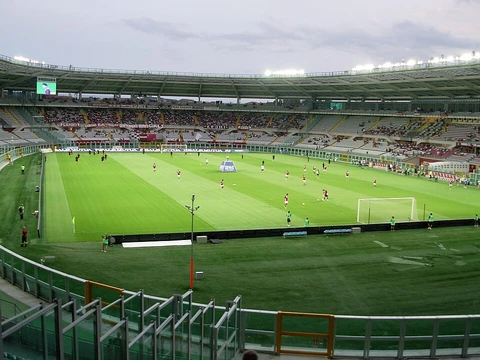
The fog comes off the Po at half-time, threading between the floodlight pylons like pale smoke. In the Curva Sud, a man in a faded 1948 shirt presses his forehead against the concrete barrier and whispers a name he learned from his father, who learned it from his. The drums restart. The pitch below is slick, the grass cut short and sharp-smelling, and somewhere in the stands a child is being held up on a shoulder, small and bewildered, watching two thousand scarves swing in unison like a single dark-red wave. The derby is not yet decided. It will not be decided for another thirty minutes. But the city has already made its choice, the way it always has: quietly, completely, without looking back.
Reader's Guide
The Stadio Olimpico Grande Torino rose from the industrial plain of the Po in 1990, built for the World Cup and christened Stadio delle Alpi after the peaks that crown the city. It has since shed names like a chameleon—Olimpico, then back to its full title—but the concrete bowl has always held the same dark-red tide. Inside the Curva Sud, the ultras have kept the flame since the 1970s, their choreography of scarves and drums a living archive of a club that lost its entire side to a plane crash over the Superga hill in 1949. The songs are not performed; they are exhaled. 'Granata, granata, granata' rolls through the throat like a vow, and on derby nights the air smells of wet grass, burnt pyro, and the particular chill of a Piedmontese evening pressing against the floodlights. Turin is a city of factories and cathedrals, of Fiat assembly lines and the glass spire of the Mole Antonelliana. Its pride is quiet, almost stubborn—the pride of people who built engines and now build memories. The melancholy is real: a city that once dominated Italian football and now carries that dominance as a weight rather than a crown. Yet the Granata never look away. They stand, they sing, they bleed the same shade of red their grandfathers wore, and the pitch below them smells of cut grass and diesel, as if the whole industrial valley has leaned in to listen.
Did You Know?
- The Superga air disaster of 4 May 1949 killed every member of Torino's first team, the coaching staff, and three journalists in a single crash; the club had to rebuild its entire squad from scratch the following season.
- Torino's seven league titles are all officially recognized as Serie A championships, including the 1927–28 Divisione Nazionale and the 1945–46 season, all concentrated between 1928 and 1949—a span of just twenty-one year
More in Stadium & Culture
Elsewhere in the Torino FC universe
Spotted an error? Know more?
This is a living reference — every entry is fact-audited, and reader corrections feed straight into our audit queue. Suggest an edit · See this site's audit record