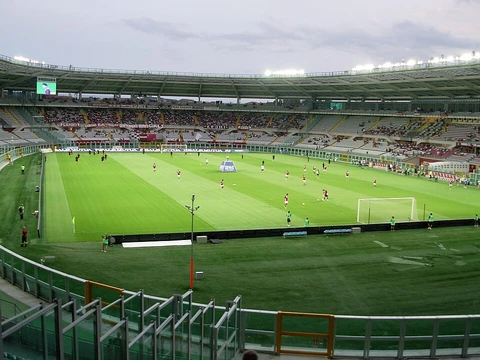
Curva Sud
Seven Scudetti, one tragedy, and a stand that never stopped roaring.

The Curva Sud is the ultras section of Torino Football Club, occupying the south stand of the Stadio Olimpico Grande Torino in the Italian city of Torino. It is the loudest, most emotionally charged corner of the ground and the self-appointed voice of the granata faithful, a role that stretches back through decades of Italian ultras culture. More than a seating area, the Curva Sud functions as a living archive of club identity: the chants, the scarves, the rituals, and the unbroken thread of support that connects a 1949 tragedy to a modern-day Serie A evening. For the city of Torino, the south stand is where the bull on the crest stops being a symbol and becomes a feeling.
- Stadium built
- 1933 (originally Stadio Comunale, renovated for 2006 Winter Olympics and renamed Stadio Olimpico Grande Torino)
Lore & Background
The identity of the Curva Sud is inseparable from the identity of Torino itself. The city is an industrial heartland of northern Italy, a place of foundries, railways, and working-class pride. When the Superga disaster of May 1949 took the entire first-team squad in a plane crash, the grief that settled over the city became part of the club's DNA. The Curva Sud carries that memory: a refusal to let the story end in mourning, a determination to rebuild and to be proud again. Torino's seven Serie A titles, their most recent in 1976, are recited in chants the way other cities recite saints. The Superga loss is not a footnote; it is the wound around which every other memory organises. The ultras of the south stand see themselves as custodians of that continuity, linking the players of the 1940s to the modern squad through an unbroken chain of song and presence. On matchdays the Curva Sud operates as a single organism: coordinated drumming, choreographed scarves, and a wall of granata that swallows the concrete of the stand. The atmosphere is less spectacle than devotion, a sustained, almost liturgical noise that tells the visiting team they are guests in a city that has already survived its worst day and will not be rattled by a ninety-minute contest.
In Their Own Story
The floodlights hum to life and the Curva Sud exhales. A thousand scarves rise in unison, a dark-red tide against the grey November sky. Someone strikes the first drum beat, then another, and the rhythm locks into the chest like a second heartbeat. The smell hits before the sound fully does: wet grass, the sharp bite of a pyro flare, the warm plastic of the seats still holding the day's heat. A boy in the third row clutches his grandfather's old granata scarf, the one with the faded crest, and sings the words he learned at six. Across the pitch, the ball bounces under the lights. In the south stand, nobody watches the ball. They watch each other, and the bull on the banner, and the city beyond the stands, and they sing.
Reader's Guide
The ground was born in 1990 as Stadio delle Alpi, a concrete bowl raised for the World Cup, and for decades carried that name before shedding it for the more intimate Stadio Olimpico di Torino. Before the Alpi, the club called home the old Filadelfia, a smaller, more personal arena where generations learned to love the granata shirt. In the south stand, the Curva Sud has been the voice of that love since the ultras tradition took root in Torino. On a Derby della Mole night the air thickens with smoke from flares, the bass of drums shakes the concrete, and a single sustained chant drowns out the opposing end. The smell is unmistakable: cut grass, hot plastic seats, the metallic tang of a flare burning down. Torino the city mirrors the club. It is an industrial town that built its identity on steel and pride, a place that lost an entire team in a 1949 plane crash and never quite stopped mourning. That melancholy sits in the stands like a second skin. The bull on the crest is not a mascot; it is a promise that the city will not be broken twice.
Did You Know?
- The Superga air crash of 4 May 1949 killed the entire Torino first team; the club was reconstituted from lower divisions and the event remains the defining trauma in the club's collective memory.
- Torino has won the Serie A championship seven times, with their most recent title coming in the 1975–76 season.
- The derby against Juventus is called the Derby della Mole, named after the Mole Antonelliana, the city's iconic domed landmark visible from the stadium.
- The club's long-time home before the 1990 World Cup was the Stadio Comunale (now Stadio Olimpico Grande Torino), where they played from 1958 to 1963 and again from 1965 to 1990.
Frequently Asked Questions
What is the Curva Sud of Torino FC?
It is the ultras supporters' section of Torino Football Club, taking its name from the south stand it occupies at the Stadio Olimpico Grande Torino. Fans regard it as the self-appointed voice of the granata faithful and the emotional core of the club's matchday identity.
Where is the Curva Sud and what stadium does it sit in?
The section is located in the south stand of the Stadio Olimpico Grande Torino, in the Italian city of Torino. That ground was originally constructed in 1990 as the Stadio delle Alpi to host FIFA World Cup fixtures before being renamed for the club.
What makes the Curva Sud more than just a row of seats?
It operates as a living archive of club culture, preserving chants, scarves, and matchday rituals that tie the 1949 Superga air disaster to a modern Serie A evening. Within Italian ultras culture, the stand has maintained that unbroken thread of devotion for decades.
How does the Curva Sud relate to the 1949 Superga tragedy?
The section treats the 1949 plane crash, which killed the bulk of the first team, as a foundational wound woven into every chant and ritual. Seven Scudetti and one catastrophe together form the narrative the ultras carry into every match.
What is the biggest rivalry the Curva Sud faces and what do they call it?
The principal derby is against Juventus, locally known as the Derby della Mole, where the granata colours and the Bull emblem go head-to-head with their cross-town rivals. It is the fixture where the south stand's volume and intensity reach their peak.
More in Stadium & Culture
Elsewhere in the Torino FC universe
Spotted an error? Know more?
This is a living reference — every entry is fact-audited, and reader corrections feed straight into our audit queue. Suggest an edit · See this site's audit record