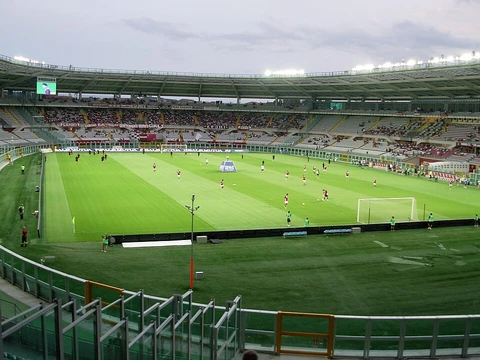
I Granata
A bull in dark red, born of fog and iron, unbroken by a sky that fell.

via Wikipedia: Torino FC · see source
I Granata is the identity that binds Torino FC to the city of Turin: a deep, almost aubergine red that stains the stands, the scarves, the fog. It is not merely a kit colour but a working-class creed, a bull's head on a crest, a name whispered in the Curva Sud with the same reverence other cities reserve for saints. The phrase captures everything the club means to its people — stubbornness, pride, a refusal to be swallowed by the black-and-white giant across the river.
- Founded
- 1906
- Colours
- Granata (dark red / maroon)
- Nickname
- I Granata / I Toro
- Stadium
- Stadio Olimpico Grande Torino
- Scudetti won
- 7
- Historic tragedy
- Superga, 4 May 1949
- Great rivalry
- Derby della Mole (vs Juventus)
Lore & Background
The story of I Granata cannot be told without the hill. Every player, every member of the travelling party, was killed. The city went silent. The club was refounded from the ashes, and the red shirts that followed carried a grief no other football club in Europe has had to wear. The Superga memorial, a simple plaque and a small chapel on the hillside, remains a place of quiet pilgrimage for granata fans to this day.
In Their Own Story
The fog was already settling over the Po when Marco laced his boots in the narrow lane behind the old Fiat plant. He was twenty-three, a factory fitter, and he had the same faded scarf his nonno had worn in '49 — the one that still smelled faintly of pipe tobacco and rain. The walk to the stadium took forty minutes through streets that smelled of roasting chestnuts and diesel. At the turnstile he pressed his ticket to the light and felt the familiar ache behind his eyes, the one that never quite fades. Inside, the Curva Sud was already a living thing: drums, a single bass note that you felt in your sternum before you heard it, and the red — God, the red — stretching up into the half-dark like a wound that refused to close. The ball was kicked off. The bull roared. And for ninety minutes the fog outside did not matter, the grey did not matter, the world beyond the river did not matter. There was only the granata, and the hill, and the ones who did not come back.
Reader's Guide
The current ground was built in 1990 for the World Cup and opened as the Stadio delle Alpi, a modern bowl of concrete and glass in the Valentino district. It has since shed that name and now carries the Grande Torino in its title, a permanent nod to the 1940s side. Before 1990, the club called home the Stadio Filadelfia for nearly seven decades, a smaller, more intimate ground that defined a generation of granata football. The Curva Sud is the beating heart. Ultras have occupied the south stand since the early 1980s, building a culture of choreography, tifo, and songs that predate the modern stadium. The repertoire is old — the 'Toro' chant, the granata hymns, the Superga tribute sung in a low, almost funereal register that makes the hair on your arms rise. On a Derby della Mole night the atmosphere shifts into something almost sacred. The pitch smells of freshly cut grass and cold earth. The drums hit a rhythm that syncs with the crowd's breathing. Across the river, the other city glows in black and white. Here, in the red, there is only the bull, the fog, and the memory of a sky that fell on a May morning in 1949. Turin does not celebrate. It endures. And the granata endure with it.
Did You Know?
- The 'Grande Torino' of the 1940s won five consecutive Italian league titles before the Superga disaster wiped out the entire travelling party in a single air crash.
- The Derby della Mole, Torino's rivalry with Juventus, is among the oldest and most fiercely contested city derbies in all of Italian football.
- The granata (dark red) identity has been central to the club since its founding era in 1906, deliberately setting the team apart from the black-and-white of its cross-river rivals.
- The Basilica of Superga, where the 1949 crash occurred, still holds a memorial to the lost players and remains a site of pilgrimage for Torino supporters.
More in Stadium & Culture
Related in Torino FC
Links follow this subject's own source article.
Elsewhere in the Torino FC universe
Spotted an error? Know more?
This is a living reference — every entry is fact-audited, and reader corrections feed straight into our audit queue. Suggest an edit · See this site's audit record