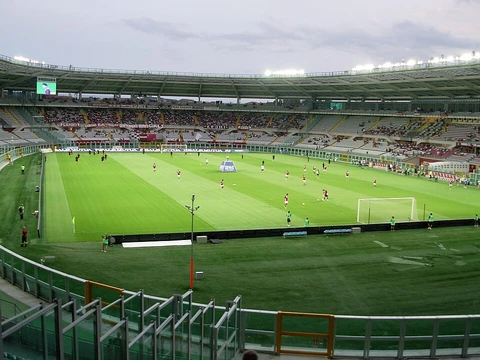
Stadio Olimpico Grande Torino
A grey-bellied temple where a working city hammers out grief and glory under flat northern light.

The Stadio Olimpico Grande Torino is the home ground of Torino Football Club, situated in the western part of Turin, Italy. Originally opened in 1933 as Stadio Municipale Benito Mussolini, it hosted matches for the 1934 FIFA World Cup but was not built specifically for that tournament. The stadium became Torino's home in 1963, when the club moved from Stadio Filadelfia to the then-Stadio Comunale. For over two decades, Torino and Juventus shared a different venue—Stadio delle Alpi—from 1990 to 2006, making it one of the few Italian grounds where two rival clubs coexisted under the same roof. More than a venue, the stadium is a cultural anchor for a city defined by industry, stoicism, and a deep, inherited grief. It is where the ultras of the Curva Maratona turn a concrete bowl into a cathedral of sound, where the Derby della Mole is fought, and where the memory of the 1949 Superga tragedy still hangs over every season like a low grey cloud.
- Location
- Turin, Piedmont, Italy
- Opened
- 1933
- Original name
- Stadio Municipale Benito Mussolini
- Current name
- Stadio Olimpico Grande Torino
- Renamed
- 2016
- Primary tenant
- Torino FC
- Built for
- 1934 FIFA World Cup (original, but not specifically built for it), 1990 FIFA World Cup (Stadio delle Alpi was a new stadium built for the tournament)
Lore & Background
The stadium was originally built in 1933 as Stadio Municipale Benito Mussolini, a civic project that predated its later fame. It was not a replacement for Stadio Filadelfia; Torino only moved here in 1963, when the ground was known as Stadio Comunale. For the 1990 World Cup, a completely new stadium, Stadio delle Alpi, was built in the same area as the old Stadio Comunale (near the current Stadio Olimpico), not in the Santa Rita district. This new arena became the shared home of Torino and Juventus from 1990 to 2006, alternating home fixtures, their fans occupying opposite curves, the tension of the Derby della Mole a weekly ritual that gave the neutral stands a charged, almost theatrical electricity. The old Stadio Comunale was later renovated and renamed Stadio Olimpico, which Torino has used since 2006. The ultras' culture here is rooted in the Curva Maratona, the main stand behind one goal, where the oldest tifosi groups have maintained an unbroken chain of passionate, sometimes defiant support through decades of relegation, promotion, and heartbreak. Their choreography — vast granata banners unfurled in unison, drums keeping a relentless 4/4 pulse, the call-and-response chants that shake the concrete — is less spectacle than liturgy. The shadow of Superga — the 1949 air disaster that killed the entire Torino first team and staff — is inseparable from the stadium's identity, even though the tragedy occurred when the club was still at Filadelfia. Every season opener, every anniversary, every moment of collective silence in the stands carries that weight. The stadium is not a place of carefree celebration; it is a place where joy is earned, where a win tastes bittersweet because the city remembers what it lost, and where the granata shirt is worn as much in mourning as in pride.
In Their Own Story
November. The sky over Turin is the colour of wet concrete, and the floodlights have just flickered on above the Curva Maratona. A young boy, maybe eight, presses his face against the rail. His grandfather's scarf — faded granata, the letters barely legible — is draped over his shoulders, too long, pooling on the ground. The drums start. Not a song yet, just a heartbeat, a thud-thud-thud that he feels in his sternum before he hears it. Then the chant rises, a low roar that swells and swells until the concrete vibrates under his sneakers. Somewhere in the crowd a flare is lit, and for three seconds the whole curve is bathed in a deep, arterial red that looks like the colour of old blood. The boy's mother squeezes his hand. On the pitch, a Torino midfielder takes a free kick, and the entire stadium — twenty-eight thousand voices — exhales as one. The ball arcs. The net ripples. And for a moment, in that grey and golden instant, the city is not grieving. It is alive. Then the whistle blows, the drums resume, and the melancholy settles back over the stands like snow over the Mole Antonelliana, patient and permanent.
Reader's Guide
The Stadio Olimpico Grande Torino rose from the grey industrial plains of Turin in 1990, replacing the beloved Stadio Filadelfia, home since 1923. Built for the FIFA World Cup, it was christened Stadio delle Alpi — a nod to the Alps that frame the city — before being renamed in the mid-2010s to its current title. The structure is functional, modern, unpretentious: four tiers of concrete seating wrapped around a rectangle of grass, with the Mole Antonelliana visible above the far stand on clear days. Step inside on a derby night and the air thickens. The Curva Maratona — Torino's ultras — erupt in a wall of granata scarves, drums, and the thunderous chant "Torino, Torino, Torino, Torino!" The Fossa dei Leoni answers from the opposite end. The smell is unmistakable: cut grass, wet wool, the faint sweetness of pyrotechnics burning in the cold November air. This is a city that built cars and endured war, that lost an entire team to a plane crash over the hills in 1949 and never fully recovered its innocence. The melancholy is structural, baked into the granite. Torino FC does not play with the swagger of the south; they play with the stoic, slightly wounded pride of a working-class city that refuses to be forgotten. The stadium is not a cathedral. It is a workshop where grief and glory are hammered out, season after season, under flat grey light.
Did You Know?
- For roughly sixteen years (1990–2006), Stadio delle Alpi served as the shared home ground of both Torino FC and Juventus, the two great rivals of Turin, before Juventus moved to their own dedicated arena and Torino moved
- The Torino–Juventus fixture is known as the Derby della Mole, named after the Mole Antonelliana, the city's iconic 19th-century landmark visible from the stands.
- The stadium was originally built in 1933 as Stadio Municipale Benito Mussolini, then renamed Stadio Comunale, and later renovated and renamed Stadio Olimpico Grande Torino in 2016. It was not rebuilt as Stadio delle Alpi
Frequently Asked Questions
Who is Stadio Olimpico Grande Torino?
It is the home ground of Torino FC, located in the western part of Turin, Italy. Originally opened in 1990 as Stadio delle Alpi to host FIFA World Cup matches, it was later renamed to honour the club it serves. It took over from the historic Stadio Filadelfia as the granata's base.
What is Stadio Olimpico Grande Torino's role in Italian football?
The stadium is the primary venue for Torino FC's league and European fixtures. For more than twenty years it also doubled as Juventus's home, making it one of the very few Italian grounds where two bitter rivals shared the same pitch. Beyond matchdays, it functions as a cultural anchor for a city shaped by industry and stoic pride.
How does Stadio Olimpico Grande Torino's story end?
The stadium's narrative is still unfolding; it remains an active, operational home for Torino FC rather than a retired or demolished landmark. Its long-term future will depend on the club's sporting trajectory and any municipal plans for redevelopment in Turin. As of the current canon, no definitive 'ending' has been written.
Why is Stadio Olimpico Grande Torino important to Torino fans?
It is the physical embodiment of granata identity in a city defined by hard labour, quiet dignity, and a deep, inherited grief. The ground carries the memory of the 1990 World Cup, the long Juventus co-tenancy, and the transition away from the beloved Filadelfia. For supporters, walking through its gates is an act of belonging to something older than any single season.
What is the link between Stadio Olimpico Grande Torino and Stadio Filadelfia?
The Filadelfia was Torino FC's long-standing home before the club relocated to the new, larger stadium in 1990. That move marked a generational break, trading an intimate, industrial-era ground for a modern World Cup venue. For older supporters, the Filadelfia still represents the emotional origin of their club, while the Grande Torino is where the story continues.
More in Stadium & Culture
Elsewhere in the Torino FC universe
Spotted an error? Know more?
This is a living reference — every entry is fact-audited, and reader corrections feed straight into our audit queue. Suggest an edit · See this site's audit record