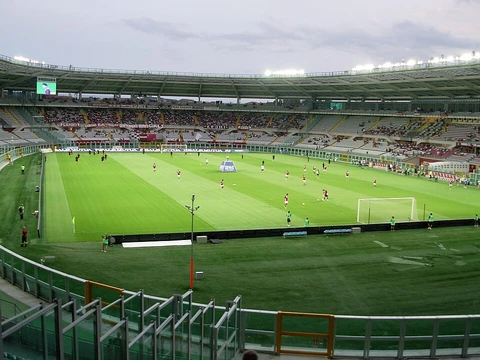
Torino vs Juventus, Derby della Mole, 1943-44
In a city at war, red and black refused to go silent.

The Derby della Mole of the 1943-44 season stands as one of the most emotionally charged encounters in the Torino–Juventus rivalry, played in a Turin still shadowed by the Second World War. With the city under the strain of occupation, rationing, and the constant hum of distant artillery, the match at the Stadio Filadelfia carried a weight far beyond three points. For the Granata faithful, it was a declaration of identity: that Torino, the city, and its red-and-black club would endure whatever the century threw at them.
This derby is not remembered for a single goal or a tactical masterclass, but for what it represented — football as defiance, community as shelter, and the unbroken thread connecting the 1940s to the coming era of the Grande Torino. It is the derby that whispered to the future: the city would rebuild, and its club would rise again.
- Rivalry
- Derby della Mole (Torino FC vs Juventus FC)
- Season
- 1943–44 Campionato
- Location
- Turin, Italy — Stadio Filadelfia
- Context
- World War II; Italian football under wartime disruption
- Significance
- One of the last peacetime-era derbies before the war reshaped Italian football and the city itself
Lore & Background
The 1943-44 season unfolded against a backdrop of occupation, food shortages, and a population living under the shadow of Allied bombing. Yet Italian football, remarkably, continued. The Derby della Mole in that season was not a spectacle of polished technique or roaring crowds of fifty thousand; it was something rawer, more intimate. The stands at Filadelfia held fewer souls than in peacetime, but every single one of them was there by choice, by stubbornness, by love for a shirt that had carried them through the 1927 Scudetto and the long, painful years that followed.
For Torino, the 1940s would become the most extraordinary decade in the club's history — the three consecutive Scudetti of 1946, 1947, and 1948, the invincibility of the Grande Torino, and then the unthinkable tragedy at Superga in May 1949. The 1943-44 derby sits in the prologue to all of that: the last breath of a world that was about to be shattered and remade. The players who laced their boots that day carried no sponsor logos, no television cameras overhead. They carried the weight of a city that needed a story to believe in.
Juventus, the neighbours across the Po, the club of the rich and the industrial, had their own wartime narrative. But in the derby, none of that mattered. It was always, and only, Granata against Bianconeri. The Mole Antonelliana loomed over the city like a cathedral spire, and beneath it, two teams from the same streets, the same factories, the same queues for bread, met on the pitch. The 1943-44 derby is remembered not for a scoreline but for the feeling: that football, even in the darkest year of the century, was the one thing in Turin that still made sense.
In Their Own Story
The November air bites through the thin wool of your jersey. You are twenty-three, a fitter at the Fiat works, and you have walked forty minutes to Filadelfia because the tram does not run on derby days — it never has, not really. The stands are not full. They will never be full again for a long time. But the section behind the goal is packed, a wall of red and black faces, breath fogging in the cold, a woman holding a child up on her shoulders so he can see the pitch.
The whistle blows. The ball moves. For ninety minutes, the war is not here. There is only the thud of a boot, the cry of a defender, the roar that rises from the Granata end when the ball bends toward goal. At minute eighty, the crowd is on its feet, not because of what is happening but because of what it means — that they are still here, still shouting, still red and black in a grey world. The final whistle comes. You do not know if it was a win or a loss. It does not matter. You walk home through the dark streets of the Borgo, past the shuttered shops, past the Mole's silhouette against a bruised sky, and you feel, for the first time in weeks, that the city is still alive. That Torino is still Torino. That the shirt still means something. And that is enough. That has always been enough.
Reader's Guide
1943–44 Campionato — Derby della Mole, Torino vs Juventus, Stadio Filadelfia, Turin.
The season is the last full one before the war swallows everything whole. The pitch is patchy, the floodlights (if there are any) are dim, and the crowd is thinner than memory. But the Granata end is a solid block of red and black, and that is the only attendance that matters.
Minute 12: a long ball finds the Torino forward, who shoulders a Juventus defender into the touchline. The crowd exhales. Minute 34: a Juventus counter, the Bianconeri winger cutting inside — the section behind the goal goes silent, then erupts when the Torino full-back slides in and claws the ball away. Minute 60: the match is a knife-fight, no pretty passing, just grit, tackles, the sound of studs on hard ground. Minute 80: you are on your feet. Everyone is on their feet. The Torino striker gets the ball in the box, turns, shoots — and the net ripples. The roar that follows is not a cheer; it is a release, a year of fear and hunger and silence breaking open in one sound. The Juventus end is quiet. The Mole is above you, indifferent and eternal.
Final whistle. You do not remember the score. You remember the feeling: that in the worst year of your life, you stood in a cold stadium and felt, for ninety minutes, that the world had not yet ended. That the shirt still meant something. That Torino was still Torino.
In club mythology, this derby is the quiet ancestor of everything that followed — the Grande Torino, the three titles, the tragedy at Superga. It is the match that said: we will be here when the war is over. And we were.
Did You Know?
- The Derby della Mole takes its name from the Mole Antonelliana, Turin's iconic landmark, which looms over the city and is visible from both the Stadio Filadelfia and the Juventus Stadium grounds.
- The 1943-44 season was played under the extraordinary conditions of World War II, with Italian football continuing in a city under occupation and rationing — a testament to how deeply the sport was woven into daily life.
- The 1940s would become Torino's most extraordinary decade: three consecutive Scudetti (1945-46, 1946-47, 1947-48) with the legendary Grande Torino side, followed by the devastating Superga air disaster of 19 May 1949.
- The Torino–Juventus rivalry is one of the oldest and most intense in Italian football, rooted in the city's geography, class divisions, and the simple fact that two great clubs share one city, one Mole, and one set of st
More in Iconic Matches
Elsewhere in the Torino FC universe
Spotted an error? Know more?
This is a living reference — every entry is fact-audited, and reader corrections feed straight into our audit queue. Suggest an edit · See this site's audit record