Torino FC
Seven Scudetti, one impossible silence, and a bull that never stops charging.

Torino Football Club, known to the world as I Granata and to their city simply as Il Toro, is one of Italy's oldest and most storied football institutions. Founded in 1906 by workers in the Turin industrial district, the club carries the dark-red (granata) shirt and the charging bull as emblems of a working-class identity that set it apart from the more bourgeois clubs of the peninsula. Their history is inseparable from the city of Turin itself: the factories, the Po Valley, the Mole Antonelliana on the horizon, and the shadow of Mount Superga.
- Founded
- 1906 (as Torinese Football Club; renamed Torino FC in 1927)
- Nickname
- I Granata / Il Toro
- Stadium
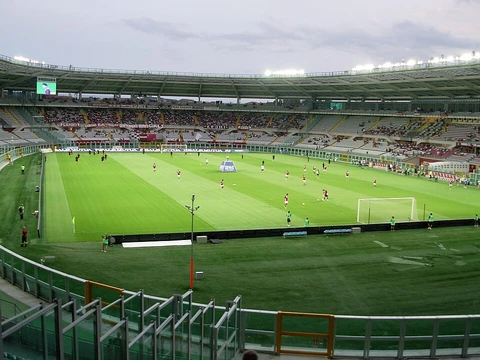
- Stadio Olimpico Grande Torino (opened 1990)
- League titles (Serie A)
- 7
- Colours
- Granata (dark red) and black
- City rivalry
- Derby della Mole (vs Juventus)
- Defining tragedy
- Superga air disaster, 4 May 1949
Lore & Background
The story of Torino FC is, in many ways, the story of Italian football compressed into one city. The club was born in 1906 among the workers of Turin's industrial belt, and from the first season the granata shirt was a class statement as much as a kit choice. Through the 1920s and into the 1940s, Torino built a dynasty that dominated the domestic game, collecting seven league titles and establishing a style of direct, physical, unapologetically working football that contrasted sharply with the more polished southern clubs. The team of the late 1940s, often called the All Blacks for the dark kit, featured players like Valentino Mazzola, Giuseppe Ferraris, and Ezio Loik, and was widely regarded as the greatest side in world football before the war.
In Their Own Story
It is a Tuesday in November. The sky over Turin is the colour of wet slate, the kind that promises nothing. You push through the turnstiles of the Stadio Olimpico Grande Torino and the cold hits your face, but the Curva Sud is already a wall of noise — scarves, drums, a low thrum that builds like a machine winding up. A young kid in a size-too-big granata jersey stands on the concrete step, eyes closed, mouthing the words of the 'Toro' chant. His grandmother's scarf is around his neck. He does not know the name of the man who died on the hill in 1949. He does not need to. The silence before kickoff is long enough for him to feel it: a pause that belongs to no other stadium in Italy, a held breath that says *we remember, we are still here, the bull still charges.* The whistle blows. The Curva detonates. The kid opens his eyes. The match begins.
Reader's Guide
The Curva Sud is where the soul lives. You don't walk into Stadio Olimpico Grande Torino the way you walk into a cathedral — you walk into it the way a worker walks into a factory at six in the morning, with purpose and a little ache. The stands are close to the pitch, the concrete is honest, and when the crowd hits the 'Toro, Toro, Toro' chant, the whole Vallette district vibrates. You feel it in your sternum before you hear it.
The granata shirt is not a colour; it is a declaration. In 1906, when the Torinese workers picked that dark red, they were saying: we are not the white shirts across the city, we are the hands that build the engines, the men who work the steel. The bull on the crest is not decoration. It is the animal that pulls the plough, that charges without apology. When a Torino striker buries his head into the ball, the Curva roars 'IL TORO!' and for two seconds the 1949 plane is not in the sky. Only the bull is.
Superga is always here. Not as a wound — as a foundation. Every match begins with a silence that no other Italian stadium produces. You understand, in that silence, that you are watching something that was almost taken, and was not. The working-class Turin that filled the factories of the Po Valley is the same Turin that fills these stands. The stadium is small, modern, a little austere. It does not need to be grand. It needs to be true.
Did You Know?
- The Superga disaster of 4 May 1949 killed every member of Torino's first team, coaching staff, and two club officials in a single aircraft crash; the club had been the reigning Italian champions.
- The granata (dark red) colour was deliberately chosen in the club's early years to signal a working-class identity, in contrast to the white and black kits favoured by wealthier northern clubs.
- The rivalry with Juventus, the Derby della Mole, takes its name from the Mole Antonelliana, the iconic dome that dominates Turin's skyline and is visible from both of the city's major stadiums.
- Torino's old home ground, Stadio Filadelfia, was demolished in 1990 and replaced by the current Stadio Olimpico Grande Torino, which was opened the same year Italy hosted the FIFA World Cup.
More in Stadium & Culture
Elsewhere in the Torino FC universe
Spotted an error? Know more?
This is a living reference — every entry is fact-audited, and reader corrections feed straight into our audit queue. Suggest an edit · See this site's audit record