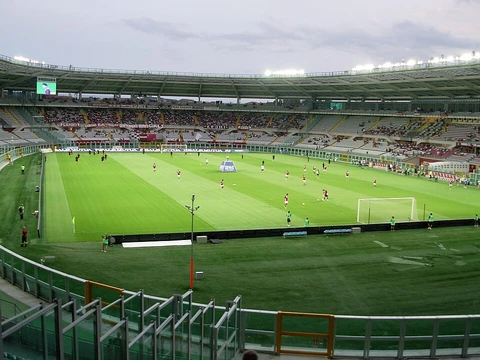
Curva Nord
Where the bull roars and the granata never go quiet.

The Curva Nord is the north stand of the Stadio Olimpico Grande Torino, the beating heart of Torino FC's fan culture. It is where the ultras, the tifosi, and generations of working-class supporters gather to create a wall of granata noise, flags, and song that has defined the identity of the club for decades. Far from a mere seating area, it is a living institution — a place where the memory of the Superga tragedy, the glory of the 1940s Scudetti, and the eternal Derby della Mole are felt in the chest before a single ball is kicked.
Standing at the north end, looking down the length of the pitch toward the south stand, the Curva Nord frames the entire experience. The concrete tiers, the sea of dark-red scarves, the choreographed tifos before kickoff — all of it speaks to a community that sees itself as inseparable from the club. Torino is not a billionaire's project; it is a city's team, and the Curva Nord is where that claim is made loud, proud, and unapologetic.
- Location
- North stand, Stadio Olimpico Grande Torino, Turin, Piedmont, Italy
- Affiliation
- Torino FC – Curva Nord ultras and tifosi
- Club colours
- Granata (dark red / maroon)
- Emblem
- The Bull (Il Toro)
- Stadium origin
- Built for the 1990 FIFA World Cup
- Principal rivalry
- Derby della Mole (vs Juventus)
Lore & Background
The Curva Nord did not emerge from a single moment but from a long accumulation of grief, triumph, and stubbornness. The shadow of the 1949 Superga air disaster — in which the entire first team and many others perished — cast a permanent, sacred weight over the club. The Curva is, in part, a collective act of remembrance: every season, every chant, every raised flag is a refusal to let that loss erase the identity of a team that had been the best in Italy for a decade. The ultras carry that memory not as a burden but as a bond, a reason to be louder, more committed, more unbreakable than any rival.
The working-class roots of Torino — the city of factories, of the Fiat workforce, of the Po Valley labourers who once filled the old Stadio Filadelfia — are the bedrock of the Curva's culture. This is not a stand of casuals who buy a ticket once a year. It is a community that has passed down the 'Toro' chant, the granata scarf, the knowledge of every player's name, from father to son for generations. The Curva Nord is where that inheritance is performed, week in and week out, in the cold Piedmontese air.
In the Derby della Mole, the Curva becomes something almost mythic. The tension between Torino and Juventus is not merely sporting; it is a class narrative, a city divided between the old industrial heart and the corporate gloss. The Curva Nord does not just watch that match — it wages it, in song, in flag, in the physical vibration of thousands of bodies pressing forward as one. After the final whistle, whether in joy or in the bitter silence of defeat, the Curva stands together. That unity, that refusal to be diminished, is the truest lore the stand holds.
In Their Own Story
It is a February evening in Turin, and the rain has finally stopped but the air still smells of wet concrete and cheap coffee from the bar on the Via Verdi. The floodlights buzz to life, casting a hard white glow over the granata seats. A man in his sixties, scarf wrapped three times around his neck, presses his forehead against the cold railing of the upper tier. Beside him, his teenage daughter drums her fingers on the concrete, humming the 'Toro' chant she learned from him at six years old. Below them, the lower tier is a churning sea of dark red, flags snapping, a giant banner being unfurled with a groan of ropes and shouted counts. The sound builds — not a roar, not yet, but a low, tectonic hum that you feel in your molars before you hear it with your ears. The players walk out. The Curva Nord erupts. And for ninety minutes, the city is one voice, one colour, one bull charging forward.
Reader's Guide
You enter through the north concourse, and the first thing that hits you is the sound — a low, continuous drone of chanting that seems to come from the concrete itself. The Curva Nord rises in two main tiers, the lower section closer to the pitch where the ultras organise their choreography, and the upper tier where the older tifosi and families sit, scarves draped over the railings like a second wall of colour. The seats are a deep granata, and on matchdays the entire stand reads as a single dark-red mass, broken only by the white of flags and the black of the occasional banner.
The symbols here are not decorative; they are liturgical. The bull — Il Toro — is not just a logo on a crest. It is carved into the identity of the stand. You will see it on scarves, on the giant tifos unfurled before kickoff, on the painted concrete of the lower tier. The granata shirt, dark red almost to the point of black, is worn like a uniform of belonging. And the 'Toro' chant — that simple, thundering call — is the heartbeat. It is not a song you learn; it is a sound you inherit.
This is a working-class space. The language is direct, the humour sharp, the loyalty absolute. You will not find luxury here, and that is the point. The Curva Nord is Turin's industrial soul made audible: the rhythm of the factory shift translated into the rhythm of the chant, the pride of the labourer translated into the pride of the supporter. When the team is down, the Curva does not go quiet. It gets louder. That is the covenant.
Did You Know?
- The 1949 Superga air disaster, in which Torino's entire first team perished, is the defining trauma of the club's history and a central memory honoured by the Curva Nord to this day.
- Torino's stadium was originally constructed for the 1990 FIFA World Cup and has since been renamed multiple times, most recently as the Stadio Olimpico Grande Torino.
- The Derby della Mole, the rivalry between Torino and Juventus, is one of the most intense local derbies in Italian football and carries deep social and class overtones.
- Torino won seven Serie A titles between the late 1920s and the late 1940s, a run of dominance that makes the Superga loss all the more devastating in the club's collective memory.
More in Stadium & Culture
Elsewhere in the Torino FC universe
Spotted an error? Know more?
This is a living reference — every entry is fact-audited, and reader corrections feed straight into our audit queue. Suggest an edit · See this site's audit record