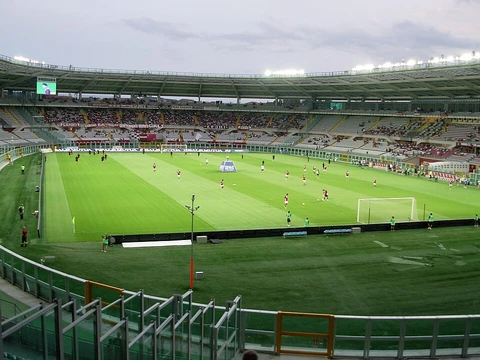
Torino vs Juventus, Derby della Mole, 1949-50 (post-Superga)
The derby played in the shadow of the sky that fell on a granata team.

The Derby della Mole of the 1949-50 season was not merely a rivalry fixture; it was a city confronting its own grief on a football pitch. Just twelve months earlier, on 4 May 1949, the 'Grande Torino' squad — the team that had won five consecutive Scudetti — perished in a mid-air collision with the Basilica of Superga. The 1949-50 Serie A campaign was Torino's first competitive season back, and every meeting with Juventus carried the weight of an entire city's mourning, its identity, and its desperate need to prove that the granata shirt still meant something.
These derby encounters became a sacred, almost unbearable ritual for Turin. The Stadio Comunale hummed with a silence that was louder than any crowd, and the sight of a Torino kit on the pitch was, for many, the first time since the crash that the club felt real again. Juventus, the neighbours, the rivals, became the foil against which a wounded city measured its own survival.
- Competition
- Serie A, 1949–50 season
- Torino final position
- 3rd
- Juventus final position
- 1st (Scudetto winners)
- Pre-disaster Torino record
- 5 consecutive Scudetti (1943–44 to 1948–49)
- Derby name origin
- Mole Antonelliana, Turin's iconic landmark
- Context
- First competitive season following the Superga air disaster of 4 May 1949
Lore & Background
Turin in the autumn of 1949 was a city still wrapped in black. The Superga disaster had not just killed a football team; it had severed a thread of identity that generations of workers, shopkeepers, and children had stitched into their daily lives. The 'Grande Torino' had been the city's pride, its five straight titles a banner waved in every bar and factory canteen. When that plane hit the hillside, the banner was gone, and the 1949-50 season was an act of collective reconstruction.
The derby against Juventus took on a meaning that transcended sport. For the granata faithful, watching their rebuilt side face the bianconeri was an act of defiance against oblivion. The crowd at the Stadio Comunale did not roar in the way it once had; it held its breath, and then it sang, and the singing was the point. Every pass, every challenge, was a small proof that the club still existed, that the name Torino still meant a team on the grass and not a memorial on a hill.
Juventus, to their credit, treated the fixture with a gravity that matched the occasion. There was no triumphalism, no exploiting the grief. The rivalry continued, as it always had, but in 1949-50 it was conducted in a register that felt almost liturgical. The derby was the one match of the season where the city could look at itself in the mirror and say, 'We are still here.'
In Their Own Story
The floodlights did not yet exist; it was a late afternoon in October, the kind of grey Turin sky that makes the Mole Antonelliana look like a dark finger pointing at God. The crowd filed in slowly, as if walking into a church service. No one was shouting. The granata shirts on the pitch were new, stitched by hands that had learned the kit's shape from photographs and memory. A boy in the lower tier clutched a programme from the 1948-49 season, the last one before the sky closed. When the whistle blew, the silence broke into a single, sustained note — not a cheer, a hum, the sound of a city holding its chest together. And somewhere in the stands, an old man in a flat cap wept, not because of the score, but because the team was playing, and that was enough, that was everything.
Reader's Guide
You don't remember the score. You remember the silence before the kick-off, the way the whole Stadio Comunale seemed to inhale as one lung. The granata shirts looked wrong and right at the same time — new faces, new names, but the same dark red that your father wore to the factory on match days.
Minute 20: a Torino midfielder wins the ball in the centre circle and the crowd exhales. It's not a goal, it's not even a great pass, but the relief in the stands is physical, a collective unclenching of fists. You realise you've been holding your breath since the warm-up.
Minute 55: Juventus press high, the game is tense, a challenge in the box and the whole stadium jumps as one. No one screams. They just stand up, all of them, and then sit back down. The match continues. The city continues.
Minute 80: your legs are numb from standing, your throat is raw from the singing that started in the first half and never really stopped. The Torino players are tired, visibly, but they are still running, still pressing, still fighting for every loose ball as if the shirt owes them something. And maybe it does. Maybe it owes the whole city something.
Full-time: the final whistle and the sound that comes is not a roar. It's a long, shuddering sigh of relief, the sound of a city that has survived another afternoon. The derby is over. Torino is still Torino. That is the score that matters.
In the mythology of the club, the 1949-50 derbies are not remembered for a result. They are remembered as the moment the granata shirt was pulled back out of the wreckage and put on again, in front of the whole city, and the city said, 'Yes. That's ours. Still ours.'
Did You Know?
- The 'Grande Torino' won five consecutive Serie A titles (1943–44 through 1948–49) before the Superga disaster ended that run in a single afternoon in May 1949.
- Despite losing the majority of their first-team squad in the crash, Torino still finished 3rd in the 1949-50 Serie A, a remarkable testament to the depth and character of the club's rebuild.
- The name 'Derby della Mole' comes from the Mole Antonelliana, Turin's most recognisable landmark, which stands as a shared symbol of the city that both clubs call home.
- The 1949-50 season was the first in which Torino competed after the disaster; the emotional weight of every fixture, but especially the derbies, was unlike anything in the club's history before or since.
More in Iconic Matches
Elsewhere in the Torino FC universe
Spotted an error? Know more?
This is a living reference — every entry is fact-audited, and reader corrections feed straight into our audit queue. Suggest an edit · See this site's audit record