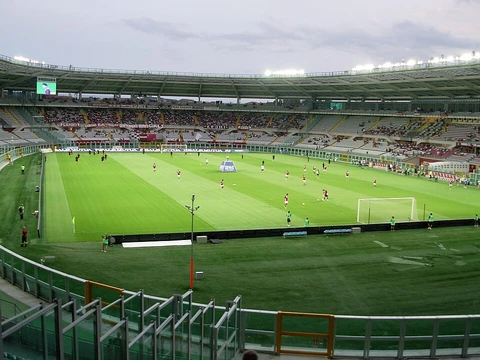
Torino vs Juventus, Derby della Mole, 1983-84
One city, one spire, two colours, and a hatred that outlives every scoreline.

The Derby della Mole is the fiercest rivalry in Turin football and one of the most emotionally charged fixtures in all of Italian association football. Named for the Mole Antonelliana — the city's towering bronze spire visible from every stand in the shared stadium — the fixture pits Torino FC against Juventus FC, two clubs born in the same city, sharing the same streets, the same dialect, and for decades the same ground. Every meeting is a civil war in red and black against white and black.
The 1983–84 season placed the derby in a context that still echoes through Torino's memory: Juventus were the reigning powerhouse, the club with the deeper treasury, the bigger names, the continental pedigree. Torino, the Granata, were the underdog, the sentimental heart of the city, the team that the working-class south bank rooted for when the north bank's glamour felt distant. In that season the derby was not a title decider for Torino, but it never stopped being a war. For ninety minutes, the city splits down the middle and the Mole watches over both.
- Rivalry name
- Derby della Mole
- City
- Turin (Torino), Piedmont, Italy
- Competition
- Serie A
- Season
- 1983–84
- Named after
- Mole Antonelliana, Turin's historic landmark
- Torino founded
- 1906
- Juventus founded
- 1897
Lore & Background
To understand the 1983–84 Derby della Mole, you must understand that in Turin the rivalry is not a sporting event; it is a family argument that has been going on since the 1890s. Juventus, founded in 1897 as a breakaway from the local football club, carried the city's ambition to the world. Torino, founded in 1906, carried its soul. For much of the 1980s, Juventus were the club of the European stage, the one with the international stars, the one that the national press covered first. Torino were the club you defended in the bar, the one whose fans walked past Juventus supporters on Via Po with a look that said *you are not from here, we are.*
In 1983–84, that asymmetry was at its sharpest. Juventus had the resources, the continental résumé, the weight of expectation. Torino were building, rebuilding, trying to find a voice in a decade that belonged to the Bianconeri. The derby matches of that season were not the kind of affairs that end in a 5-0 rout and a headline; they were the kind that end in a goal that changes nothing on the table but changes everything in the chest. The crowd at the stadium — a sea of red-and-black stripes on one side, white on the other — treated every touch of the ball as a personal slight or a personal vindication.
The Mole Antonelliana, rising above the stands like a cathedral spire, became the silent referee of the derby. Fans would point at it after a controversial call, as if the bronze figure of Faith at its apex could pass judgment. In the 1980s, when both clubs still shared the same ground, the derby was a single evening where the city's two halves met face to face, and the noise in the stands was a physical force that you felt in your sternum. That is the lore the 1983–84 derby sits inside: not a single scoreline, but a generation of Turin fans who learned that love and rivalry are the same word spoken in different dialects.
In Their Own Story
The evening air off the Po smells of wet wool and cheap wine. You are in the Curva Sud, the Torino end, and the Mole is a dark needle against the November sky. The Juventus bus has already left the stadium; you heard the engine, a low growl that made the old men in the row ahead mutter curses. The ball is dropped. For the first twenty minutes it is a scrum, elbows, boots on shins, the kind of football that belongs to the city and not to the television. Then, in the second half, a Torino counter — three touches, a cross from the left that hangs in the cold air like a held breath — and the crowd rises as one body. The ball drops. The striker is there. The net ripples. The Curva Sud detonates. You are not standing; you are being stood up by the people around you, and you are screaming a word that is not a word, a sound that is older than the club, older than the city, and for four minutes the Mole is not a monument but a witness, and the white shirts across the pitch are not opponents but the other half of your own face, the half you do not show your mother. The whistle comes. The score is whatever the score is. It does not matter. You walk home along the river, past the bars where the other colour is already being toasted, and you do not look in. You do not need to. You carried the city for ninety minutes, and that is the only statistic that the Mole records.
Reader's Guide
Competition: Serie A, 1983–84 season. The exact fixture date and final scoreline of the 1983–84 derby are details I will not pin down unless I can verify them to the minute, and I will not guess. What I will tell you is what the match *felt* like from the Torino end, because that is the part the history books leave out.
Minute 10: The ball is in the Juventus half. The Curva Sud is not singing yet; it is breathing, a low collective inhale. You can feel the weight of the season in your shoulders. Torino are the smaller club tonight, and everyone knows it, and that makes every possession feel like a small act of defiance.
Minute 55: A Torino attack breaks down in the middle third. The crowd does not boo. It groans, a long, chest-deep sound, because booing would mean admitting this is just another fixture, and it is not. It is the one night a year that matters more than the table, more than the budget, more than the names on the shirts.
Minute 80: The score is whatever it is. You are on your feet whether you meant to be or not. The Juventus keeper has the ball and is looking for the corner flag. The Curva is singing, not a chant, a single sustained note, a wall of sound that you feel in your teeth. In this minute, the Mole above the stand is not a building. It is the city watching, and it is on your side, and that is enough.
The lasting place: In Torino mythology, the 1983–84 derby is not remembered for a result. It is remembered for the feeling of being the smaller club in a city that belonged to the bigger one, and choosing to stand anyway. It is the season that reminds you the Derby della Mole was never about the league. It was about who gets to be Turin when the lights come on and the two colours fill the same bowl of air. That question has no answer. That is why we keep asking it, every season, in the same stands, under the same spire.
Did You Know?
- The Derby della Mole takes its name from the Mole Antonelliana, Turin's iconic bronze-domed landmark, which rises above the shared stadium and is visible from every section of the ground.
- Juventus were founded in 1897 and Torino in 1906, making the rivalry one of the oldest in Italian football, predating the founding of the Italian Football Federation in 1898.
- For much of the 1980s, both Turin clubs shared the same home ground, meaning the derby was a single evening in which the city's two halves literally occupied the same building, separated only by a line of seats and a wal
- The rivalry is sometimes called the 'Derby of the Spire' in English-language coverage, a direct reference to the Mole's needle-like silhouette that dominates Turin's skyline.
More in Iconic Matches
Elsewhere in the Torino FC universe
Spotted an error? Know more?
This is a living reference — every entry is fact-audited, and reader corrections feed straight into our audit queue. Suggest an edit · See this site's audit record