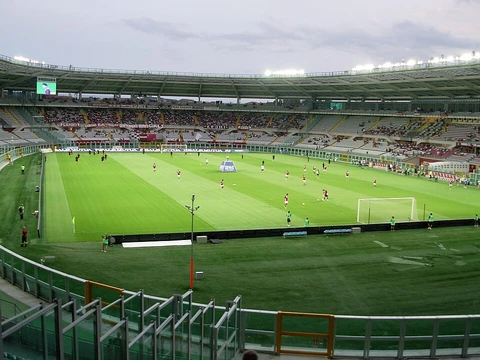
Torino vs Juventus, Derby della Mole, 1984-85
Two clubs, one city, and a hatred that the Mole Antonelliana can't hold in.

The Derby della Mole is the fiercest, most electric fixture in the calendar of Turin football: Torino FC in their deep granata against Juventus in black and white, both born in the same city, separated by a handful of kilometres and a rivalry that runs deeper than any trophy cabinet. The 1984-85 season's derby encounter sits in the broader mythology of a rivalry that has defined the identity of both clubs for over a century, a fixture where the Mole Antonelliana looms over the Stadio delle Alpi and every pass feels loaded with the weight of neighbourhood pride.
This entry is an unofficial, fan-written tribute to that era of the Derby della Mole — the mid-1980s, when Torino were fighting to reassert themselves in Italian football and every meeting with their cross-town rivals carried the raw, gut-level intensity that only a city derby can produce. No official club publication, no corporate narrative: just the memory of the stands, the noise, and what it meant to be a Toro in that period.
- Rivalry name
- Derby della Mole (named for the Mole Antonelliana, Turin's landmark)
- Home ground (Torino)
- Stadio delle Alpi, Turin
- Torino kit
- Granata (deep maroon-red) shirt and shorts
- Juventus kit
- Bianconeri (black and white stripes)
- Significance
- One of the most intense city derbies in Italian football
- Era context
- Mid-1980s, a period of rebuilding and identity for Torino in Serie A
Lore & Background
The Derby della Mole is not simply a football match. It is the oldest, most personal rivalry in Italian club football, born from the fact that two of the nation's great clubs share a single city. Torino FC, founded in 1906, and Juventus, founded in 1897, have been rivals for over a century. The name 'della Mole' — of the Mole — comes from the Mole Antonelliana, the great iron-and-glass landmark that dominates Turin's skyline and is visible from the Stadio delle Alpi. For the fans, the Mole is the neutral ground, the shared sky under which two irreconcilable identities collide.
The mid-1980s were a particular kind of crucible for Torino. The club, after the golden age of the Grande Torino and the subsequent decades of fluctuating fortune, was in a period of re-establishing itself as a serious Serie A presence. Juventus, by contrast, were in the middle of the era that would produce their legendary 1980s treble-winning squad. That asymmetry — the underdog granata against the continental giants — gave the derby a special bitterness. Every Torino player who laced up his boots for the derby knew he was expected to be the one who made the Bianconeri bleed, and the crowd at the Alpi expected nothing less.
What makes the 1984-85 derby part of the club's mythology is not a single scoreline but the cumulative weight of the rivalry in that era. The noise in the stands, the choreography of the granata sections, the way the city itself seemed to split down the middle for ninety minutes — these are the things a Torino fan remembers. The derby is not a game you watch. It is a game you survive, you celebrate, you mourn. And in the mid-1980s, surviving it meant believing that Torino still belonged among the greats.
In Their Own Story
The fog was coming off the Po and rolling over the Alpi in grey sheets, thinning just enough to let the floodlights cut through. You could see the Mole Antonelliana from the upper tier, its spire catching the light like a needle stitching the sky shut. The granata section was already a wall of colour, a thousand scarves raised and lowered in unison, the sound a low continuous roar that you felt in your sternum before you heard it with your ears. A kid next to you, maybe twelve, had a hand-painted sign: 'TORO NON MORDI MA NON SI LASCIA.' The Torino doesn't bite, but it doesn't let you go. His father had the same sign from 1976. You could tell by the way he held it, the way his knuckles whitened every time the Bianconeri touched the ball. The match was a knife-fight in the midfield, elbows and slides, the referee's whistle a thin reed against the storm. And when the final whistle came, it didn't matter what the scoreboard said. You were still standing. You were still granata. The Mole was still above you, and the city was still yours.
Reader's Guide
The 1984-85 Derby della Mole, Stadio delle Alpi, Turin. Serie A. The exact scoreline matters less than what the ninety minutes did to the people in the stands.
Minute 15: The Bianconeri sit deep, patient, confident. The Alpi is a furnace. You can feel the heat radiating from the terraces. Every Juventus pass backward draws a wave of sound that is almost physical, a collective rejection.
Minute 40: Torino press high, desperate, beautiful in their urgency. A granata winger cuts inside and the whole stadium inhales. The shot is blocked. The roar that follows is not disappointment. It is hunger.
Minute 80: This is the moment that lives in the memory. The score is tight, the legs are heavy, the fog is back and the floodlights make everything look like a painting. The Torino fans are standing, all of them, singing not a song but a single sustained note, a wall of sound that you feel in your teeth. A Juventus player hesitates on the ball, just a second, and the Alpi erupts. That one second of hesitation is worth more than any goal.
Full time. The scoreboard is a detail. What remains is the fact that you stood in that cold, in that fog, in that sea of granata, and for ninety minutes you were not a fan. You were the city. The Mole was above you. The derby was not over. It never is.
In Torino mythology, the 1984-85 derby is not a single data point. It is the season that reminded the club and the city that the rivalry is not about the table. It is about the right to exist in the same sky as the Bianconeri and refuse to be diminished.
Did You Know?
- The Derby della Mole is named after the Mole Antonelliana, Turin's iconic landmark, which is visible from the Stadio delle Alpi and has been a symbolic backdrop to the rivalry for generations.
- Torino FC and Juventus are the only two clubs in Italian football history to share the same city and both compete at the top level for sustained periods, making the derby uniquely personal compared to other Italian rival
- The term 'Derby della Mole' is used exclusively for Torino-Juventus encounters; it is not applied to any other fixture in Italian football.
- Torino's granata (deep maroon-red) colour is said to have been chosen partly to distinguish the club from Juventus' black-and-white, cementing a visual identity that is inseparable from the rivalry.
More in Iconic Matches
Elsewhere in the Torino FC universe
Spotted an error? Know more?
This is a living reference — every entry is fact-audited, and reader corrections feed straight into our audit queue. Suggest an edit · See this site's audit record