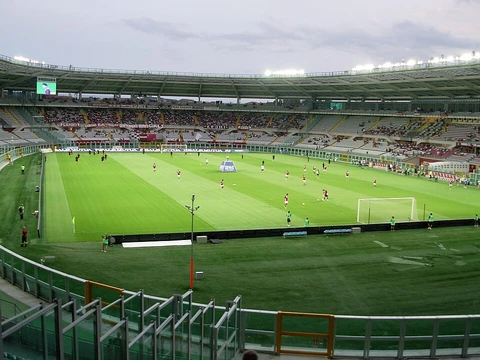
Derby della Capitale
One city, two colours, one wound that never fully closes.

The Derby della Mole—commonly called the Torino Derby—is the fierce, same-city rivalry between Torino FC and Juventus, the two professional football clubs of Turin, Piedmont. Born from a shared industrial city that produced both a working-class 'people's club' and a more cosmopolitan, internationally ambitious outfit, the derby carries a weight no other Italian fixture quite replicates: two sets of fans, two colour identities, one city, and a shared grief that no trophy can heal.
For a Torino supporter the derby is not merely a match; it is a question of who Turin truly belongs to. The granata identity—dark red, rooted in the factories of the Po Valley—stands in deliberate contrast to the bianconeri stripes. Every derby is a small civil war over the soul of the city, played out on the same patch of grass under the shadow of the Mole Antonelliana.
- Rival clubs
- Torino FC vs Juventus FC
- City
- Turin (Torino), Piedmont, Italy
- Common name
- Derby della Mole / Derby di Torino
- Torino kit colour
- Granata (dark red)
- Juventus kit colour
- Bianconeri (black-and-white stripes)
- Torino total Scudetti
- 7
- Defining shared tragedy
- Superga air disaster, 4 May 1949
Lore & Background
Turin in the early twentieth century was a city of factories, railways, and ambition. Football arrived in two registers: the elegant, internationally minded Juventus, founded in 1897 with a distinctly cosmopolitan flavour, and the rougher, more local Foot-Ball Club Torinese (1906), which became Torino FC in 1927 and quickly claimed the loyalty of the industrial working class. The two clubs occupied different social worlds even before a single derby was played, and that class divide became the emotional bedrock of the rivalry.
The 1940s forged the bond and the wound simultaneously. The 'Grande Torino' of the early-to-mid 1940s—featuring legends such as Valentino Mazzola, Ossvaldo Bagnolo, and Luis Montico—dominated Italian football, winning consecutive Scudetti and establishing a style of attacking, collective play that made the granata the team of a generation. Then, on 4 May 1949, the Superga air disaster killed the entire travelling party. The city lost its heroes in a single afternoon, and the derby was never just a match again. Juventus, as the other great club of Turin, carried the weight of being the 'other' side in a grief that belonged to the whole city.
In the decades since, the rivalry has been punctuated by transfer battles, on-field controversies, and the quiet, persistent tension of two sets of supporters sharing the same streets, the same tram lines, the same winter fog. It is a rivalry that does not need a geographic distance to feel enormous; its distance is social, emotional, and historical.
In Their Own Story
The fog rolls off the Po in the late afternoon, thick enough to swallow the Mole Antonelliana's spire. Inside the stadium the floodlights cut white shafts through the mist, and the terraces are already a sea of dark red. A Torino supporter in his fifties presses his face to the barrier and watches the Juventus players warm up in their black-and-white stripes, and for a moment the two colours look like they belong to different centuries. He does not shout. He does not need to. His grandfather was on that plane. The man next to him, also granata, also silent, taps the concrete once, twice, a small private rhythm. Then the whistle blows, the ball is kicked, and the city holds its breath like it has been holding it since 1949, waiting for a result it already knows it will grieve.
Reader's Guide
The Torino–Juventus derby is, above all, a class story dressed in football kits. Torino was the club of the metalworkers, the railway men, the families who filled the factories of the Po Valley. Juventus, with its earlier founding, its international board, and its habit of signing foreign stars, was always the club that looked outward. Both call Turin home, but they have spoken different dialects of the city for over a century, and the derby is where those dialects collide.
The Superga disaster of 1949 is the unspoken third party in every derby. Torino's 'Grande Torino'—the team that won back-to-back Scudetti in the mid-1940s—was destroyed in a single afternoon, and the city's grief is a shared burden that Juventus, as the other great Turin club, can never fully distance itself from. That shared wound makes the rivalry more intimate and more painful than any cross-city fixture.
Defining moments include the 1946–47 Scudetto, when Torino's collective, attacking football outlasted every rival; the 1975–76 title, Torino's last league triumph and a reminder that the granata could still win the city; and the countless transfer-window battles over the years, when a player's choice of badge became a small act of civic allegiance. The tension is 'same city, different world'—a dynamic no other Italian derby, separated by geography, can truly replicate.
Did You Know?
- Torino FC was originally founded in 1906 as 'Foot-Ball Club Torinese' and only adopted the name 'Torino FC' in 1927, a change that cemented its identity as the city's club rather than a neighbourhood side.
- The 'Grande Torino' of the 1940s, featuring Valentino Mazzola and Ossvaldo Bagnolo, won consecutive Scudetti and was widely regarded as the best Italian team of its era before the Superga disaster of 4 May 1949 erased th
- The derby's common name, 'Derby della Mole,' references the Mole Antonelliana, Turin's iconic landmark, which looms over the city and is visible from both stadiums—reminding both sets of fans they are, after all, neighbo
- Torino has won the Coppa Italia five times (1935, 1943, 1968, 1970, 1993), a domestic-cup record that gives the granata a distinct source of pride independent of the league title.
More in Great Rivalries
Elsewhere in the Torino FC universe
Spotted an error? Know more?
This is a living reference — every entry is fact-audited, and reader corrections feed straight into our audit queue. Suggest an edit · See this site's audit record