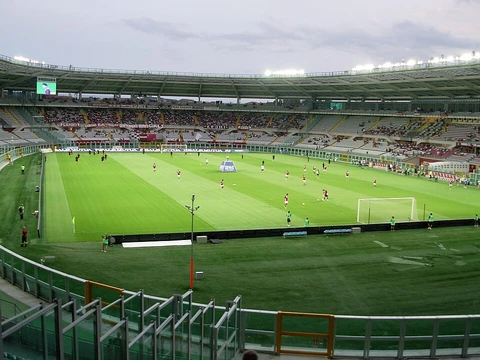
Juventus vs Inter
Two cities, two empires, one title that belongs to neither Torino.

The Derby d'Italia — the 'Derby of Italy' — is the name given to the clash between Juventus of Turin and Inter of Milan, the two most decorated and commercially dominant clubs in Italian football. It is not a derby in the traditional geographic sense; rather, it is a national rivalry that has come to symbolise the two poles of Italian sporting and industrial power: the heavy-industry conservatism of Piedmont against the cosmopolitan, fashion-and-finance energy of Lombardy. For over a century, when these two sides meet, the rest of Serie A tends to hold its breath.
From the perspective of a Torino FC supporter, the Derby d'Italia occupies a strange and sometimes painful place in the national narrative. It is the rivalry that defines the country's footballing identity in the media, yet it exists in the same city as the Granata, who are routinely written out of the 'big three' conversation. Watching Juventus and Inter trade blows at the Allianz Stadium or San Siro is, for a Toro fan, a reminder that the most important derby in Italy is the one that does not involve your club.
- Nickname
- Derby d'Italia
- Juventus founded
- 1897 (Turin, Piedmont)
- Inter founded
- 1908 (Milan, Lombardy — breakaway from the original Italian Football Club Milan)
- Juventus Serie A titles
- 36 (most in Italian top-flight history)
- Inter European Cup / Champions League ti
- 3 (1964, 1965, 2010)
- Typical label
- National rivalry, not a city derby
Lore & Background
The roots of the Derby d'Italia stretch back to the very architecture of Italian football. Juventus, founded in 1897 by a group of young men in Turin, became the first Italian club to achieve sustained continental success, and their 1930s and 1940s dominance under managers like Pozzo and Ferrari established the Bianconeri as the default champions of the league. Inter, born in 1908 from a schism within the original Milan club — a group of players and directors who wanted a more open, 'international' policy — carried from its very founding a rebellious, outsider identity. That DNA of defiance against the establishment has echoed through every era of the rivalry.
The 1941–42 season is often cited as a formative year: both Juventus and Inter finished level on points, and the title was decided by a goal-difference tie-break in Inter's favour. The bitterness of that campaign, played out under the shadow of Fascist Italy and a war-torn nation, gave the rivalry a weight that transcended sport. In the 1960s, Inter's 'Grande Inter' under Helenio Herrera, with their revolutionary catenaccio, won back-to-back European Cups (1964, 1965) and a Serie A title, while Juventus, with the legendary trio of Charley, Sarti, and the young Mazzia, remained the domestic standard-bearer. The two clubs defined Italian football in alternating waves, and every meeting between them felt like a referendum on which vision of the game would prevail.
The modern era has only sharpened the contrast. Inter's 2010 Treble under José Mourinho — Serie A, Coppa Italia, Champions League — was built in part on a season in which they outscored and outplayed Juventus, ending a long run of Bianconeri domestic dominance. Conversely, Juventus's nine consecutive Serie A titles (2012–2020) made them the undisputed domestic king, and every Inter-Juventus match during that stretch carried the weight of a champion defending against the most persistent challenger. For a Torino fan, the irony is bitter: the club in your own city, three streets away from your ground, is the one writing the headlines, while the Granata fight to be remembered.
In Their Own Story
The floodlights at the Allianz Stadium hum to life on a cold November Tuesday. The pitch is a blade of green under a sky the colour of old iron. In the away end, a sea of black-and-blue scarves rises and falls like breathing. In the home end, white and black, a chant rolls out in a low, grinding wave that you feel in your sternum before you hear it with your ears. A Torino fan in the upper tier, a faded Granata scarf knotted loosely around his neck, watches the two teams line up. He does not cheer for either. He watches the way the Juventus captain adjusts his armband, the way the Inter number ten taps the ball with his heel, and he thinks: *this is the derby they give you. This is the one that makes the headlines. This is the one where the whole country picks a side.* He sips his cold beer, says nothing, and waits for the whistle. The match will be electric. The match will be forgotten by Thursday. And Torino will still be Torino — the third name in a sentence that should have two.
Reader's Guide
Juventus (Turin, Piedmont): The rivalry exists because Juventus and Inter represent two different models of Italian power. Juventus is the industrial city's club — methodical, institutional, built on a factory-town discipline that produced the first Italian club to win a European Cup (1985). From a Torino perspective, the pain is specific and local: Juventus shares the city, the region, the very soil of Piedmont, yet the 'Derby d'Italia' frames them as a national institution rather than a local one. The 'same-city, different-world' tension is unique in Italian football — no other club shares a city with a 'big two' counterpart in this way. Defining encounters: the 1941–42 title decider (Inter edged ahead on goal difference); the 2005–06 season, where Calciopoli's aftermath relegated Juventus and handed the title to Inter, a wound that reshaped the rivalry's emotional register; and the 2009–10 campaign, when Inter's Treble run included a decisive league win over Juventus that broke a long Bianconeri scoring streak.
Inter (Milan, Lombardy): Inter's identity is built on the 1908 breakaway — a club literally founded in opposition to the establishment, which gives every meeting with Juventus an undercurrent of 'the outsider vs. the institution.' Milan is the city of commerce, fashion, and ambition; Turin is the city of engineering, patience, and quiet pride. Transfer wars have defined the rivalry: players moving between the two clubs (from Baggio to Ronaldo to various midfielders) have turned individual careers into narratives of loyalty and betrayal. The 1960s 'Grande Inter' era, the 2010 Treble, and the recurring pattern of Inter arriving as the challenger who finally breaks the champion's hold make every Derby d'Italia a story about whether the underdog's moment has come. For Torino, Inter is the rival you respect from a distance — a different city, a different world, but one that, together with Juventus, makes the national conversation feel like it has no room for the Granata.
Did You Know?
- Inter was born from a 1908 split within the original Milan club; the 'international' in its name was a deliberate statement of openness, setting it apart from the more insular Italian clubs of the era.
- The 1941–42 Serie A title was decided by goal difference after Juventus and Inter finished level on points — a result that still colours the rivalry's folklore in both cities.
- Juventus's 1985 European Cup victory in Brussels was their first, ending decades of near-misses and cementing their status as Italy's continental standard-bearer, a claim Inter would later contest with their own 1964 and
- The term 'Derby d'Italia' is not an official designation; it emerged in Italian sports journalism to distinguish this national rivalry from true city derbies like the Derby della Madonnina (Milan) or the Derby della Capi
More in Great Rivalries
Elsewhere in the Torino FC universe
Spotted an error? Know more?
This is a living reference — every entry is fact-audited, and reader corrections feed straight into our audit queue. Suggest an edit · See this site's audit record