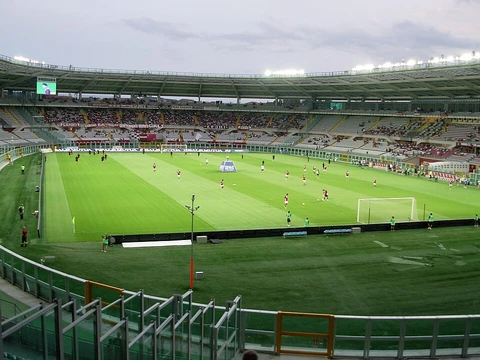
Toro
One roar, one city, one bull — the granata heart of Turin beats here.

Toro is not merely a nickname; it is the living, breathing identity of Torino Football Club and the community that surrounds its home ground. The word — Spanish and Italian for 'bull' — captures the raw, unyielding spirit of a club born in the workshops and factories of Turin, a city of metal and labor. To call yourself a Toro is to claim a lineage of grit, to say you belong to the side of the city that builds with its hands and roars with its chest.
The stadium itself — now known as Stadio Olimpico Grande Torino, in the San Salvario district — is the physical vessel of that identity. Through its many incarnations (Filadelfia, delle Alpi, and the current structure), one constant has endured: the unison bull-roar that erupts from the stands, a sound that visitors describe as almost geological, as if the earth beneath Turin were shifting. It is the heartbeat of the granata world.
- Nickname
- Il Toro (The Bull)
- Founded
- 1906
- Traditional kit color
- Granata (deep red-purple)
- Home ground (current name)
- Stadio Olimpico Grande Torino
- District
- San Salvario, Turin
- Signature stadium sound
- The 'Toro' unison bull-roar
- City rivalry
- Derby della Mole (vs. Juventus)
Lore & Background
The story of the Toro begins in the smoke and iron of early-twentieth-century Turin, a city that built the cars that would carry Italy forward. Torino FC was founded in 1906, and from its earliest seasons the granata shirt — that distinctive deep red-purple that sits somewhere between wine and violet — became a marker of the working neighborhoods. Where Juventus, just across the city, was associated with capital and polish, Torino belonged to the foreman, the welder, the family in the San Salvario tenement who followed the team on foot through the winter fog.
The bull itself became the emblem not through a single dramatic founding myth but through the slow accretion of identity: the animal's stubbornness, its refusal to be turned back, its low continuous bellow. Fans began to imitate that bellow in the stands, and over decades the 'Toro' chant evolved into a single, sustained, thunderous roar — not a song with words, but a primal sound, the whole section inhaling and then releasing in one massive exhalation. It is less a chant than a collective act of will.
The stadium has changed its name and its shape more than once, yet the emotional geography has remained fixed. The end where the most devoted supporters gather, the curved concrete tiers, the narrow aisles where the smell of stale coffee and wet wool lingers after a match — these are the coordinates every Toro child learns before they learn to read. To walk into that ground on a cold Saturday afternoon is to step into a cathedral where the liturgy is a single animal cry and the congregation wears the same shade of blood-red as the city's autumn leaves.
In Their Own Story
The fog sat low over San Salvario, swallowing the floodlights until they were just smears of white in the grey. Marco pulled his granata scarf tighter, the wool rough against his chin, and pushed through the turnstile with the rest of the crowd. Around him, two thousand voices were already humming — not singing, humming — a low vibration he felt in his molars before he heard it with his ears. The match was not yet underway. The teams were still in the tunnel. But the Toro was already awake, already breathing, already pressing its great horned head against the glass of the world, waiting for the ball to drop so it could let out the roar that would shake the dust from the concrete rafters. Marco closed his eyes. He could feel it building in his own chest, a pressure behind the sternum, the same pressure his nonno had described in 1962, in 1976, in every season he could remember. The ball dropped. The roar came. The fog, for one impossible second, seemed to part.
Reader's Guide
You enter from the San Salvario side, where the old brick façade still carries the weathered paint of decades. The concourse is narrow, concrete, functional — no luxury here, just the smell of espresso and the murmur of men in dark red scarves arguing about the last match before the match has even started. The stands rise steeply, close to the touchline, so that when the Toro roar hits, it is not a sound you hear but a pressure wave that pushes the air out of your lungs.
The granata shirt is not a color so much as a temperature: deep, warm, almost black in the shadow, blazing in the sun. It is the color of the city's autumn, of the Po river in winter, of the iron oxide that stains the workshop floors. When the whole stadium wears it, the effect is of a single living organism breathing.
The bull on the crest is not decorative. It is a declaration. The 'Toro' chant — that single, wordless, sustained bellow — is the liturgy. No melody, no verse. Just the whole section inhaling, holding, and releasing as one throat. It is the sound of a city that built Italy's cars and now builds its own identity, one roar at a time, in a small concrete bowl in the north of a country that will never stop arguing about who is richer. The Toro does not need to be. It simply roars.
Did You Know?
- The 'Toro' chant is not a song with lyrics but a single sustained animal roar produced in unison by the entire section, making it one of the most acoustically distinctive fan sounds in Italian football.
- Torino's home ground has carried several names over the decades — including Stadio Filadelfia and Stadio delle Alpi — before settling on Stadio Olimpico Grande Torino, yet the San Salvario district has remained the club'
- The granata shade of Torino's kit sits in a debated space between deep red and purple, and has been worn in essentially the same hue since the club's earliest seasons in 1906.
- The rivalry with Juventus, known as the Derby della Mole, is rooted as much in Turin's class divide — factory workers versus the city's commercial elite — as it is in footballing competition.
More in Stadium & Culture
Elsewhere in the Torino FC universe
Spotted an error? Know more?
This is a living reference — every entry is fact-audited, and reader corrections feed straight into our audit queue. Suggest an edit · See this site's audit record